Director, Katie Mitchell; Designer, Vicki Mortimer; Lighting Designer; Jon Clark. Conductor, Giacomo Sagripanti. Lucia, Nadine Sierra; Edgardo, Xabier Anduaga; Enrico Ashton. Artur Ruciński; Raimondo Bidebent, Insung Sim; Arturo Bucklaw, Andrés Presno; Normanno, Michael Gibson; Alisa, Rachael Lloyd
My younger self would have found it fairly unbelievable that I would be voluntarily going to a Donizetti opera, but I had heard such good things about this production, about the Lucia singing in it, and because I admire Katie Mitchell’s work, that I decided to travel down to see it – from a good Lower Slips seat. And in fact I did go several times in the 70’s to Janet Baker singing Maria Stuarda in the ENO production, so I do know that with the right production and singers Donizetti’s works can be a rewarding experience to see and hear.
So…..what to make of it, after all the years?
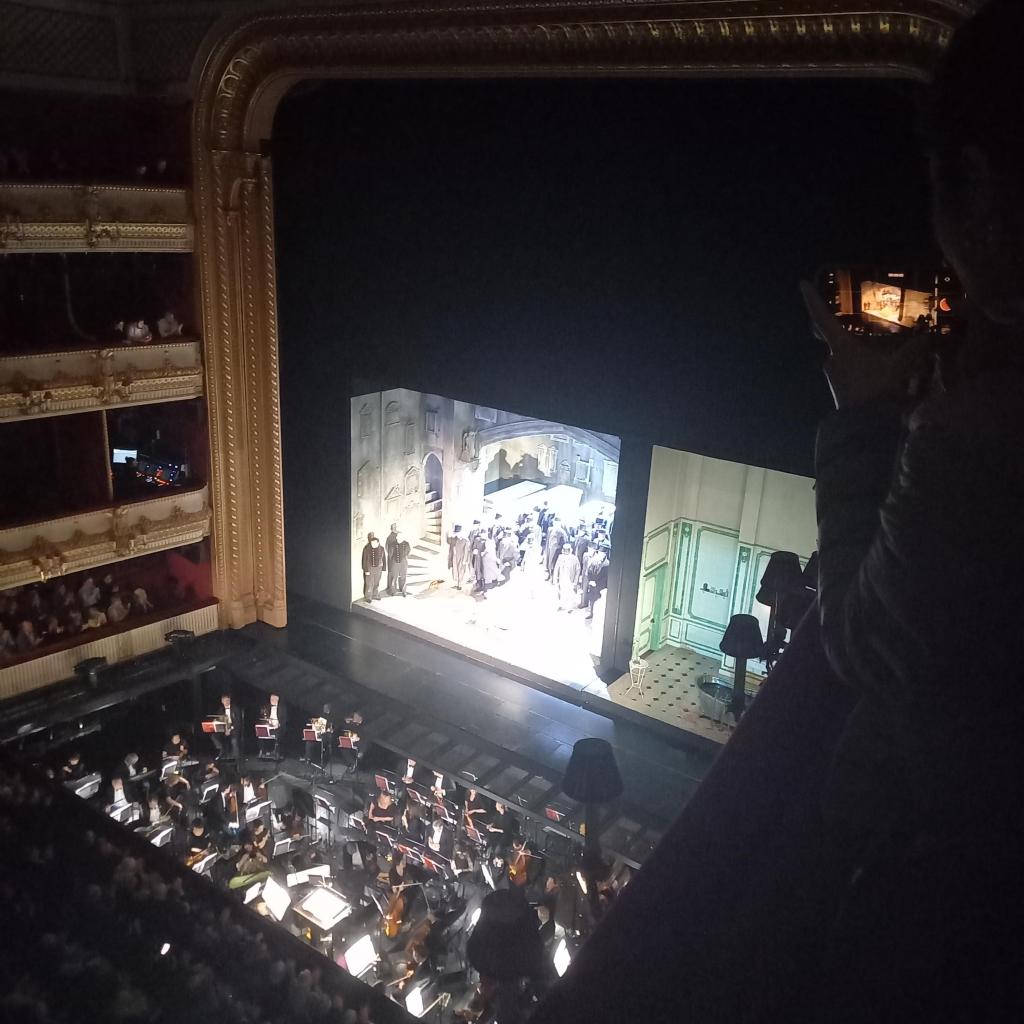
The director sets the costumes and general atmosphere as Gothic, maybe 1830’s, when the score was written. This is not when the actual opera is set – late 17th century – nor is it when the novel was written, but it serves well enough as a gloomy backdrop to an undoubtedly dark, even grotesque, work. The lighting is predominantly dim, with the exception of that on Lucia in her mad scene, and her dead mother’s ghost, seemingly in a wedding dress(?) who wanders across the stage at various key points of the action. The set design offers an interesting idea – a split screen, essentially two stage, approach, one usually Lucia’s bedroom or withdrawing room so that when one ‘screen’ offers the ‘main’ staging, the other offers sub plot or commentary – thus, while Edgardo and Enrico are arguing in the wedding celebration, we see a very sexually knowledgeable Lucia first bringing her new husband Arturo to bed and then stabbing him to death in mime. The split screen works well though obviously reduces stage space (so the chorus can look cramped at times) and – if like me you’re sitting in the Lower Slips – it can be more than usually frustrating to see what’s going on. The point of the split screen is obviously to ensure that Lucia is absolutely at the centre of what’s happening, even though the story revolves around the fact that, among all these dominating and manipulative men, she absolutely doesn’t at first sight have any agency at all. The director makes Lucia takes control where she can – e.g in her very full-on sexual advances to Edgardo – and very much shows the mad scene as the only way Lucia CAN retain some agency in her own life. Lucia ends up blood-bespattered in a Victorian bath on one side of the stage while Edgardo declares, rather at length, his intention to kill himself. Even at the end in this production therefore Lucia remains centre-stage. The sets themselves were straightforwardly realistic and natural. They were also quite solid which then required numerous pauses with curtains down to re-arrange them. This impeded the momentum of the work and I found the pauses unhelpful.
So what did I make of it all?
– Though the work is a model of concision compared to many rambling Verdi plots, I did find it overlong, really. Not only the pauses but on occasion the arias as an opportunity for display made me fidgety. I was not gripped by it. Even the Mad Scene, sadly with flute accompaniment rather than glass harmonica, just went on, for me, too long. The music somehow doesn’t really excite me even when Edgardo and Enrico are having their set-to in Act 2. There is too much of the auto-pilot, in terms of the stylised ending to arias, and also some of the thematic material just sounds to me banal and not appropriate to the emotions being played out on stage
– Specifically, though Nadine Sierra’s singing as Lucia was remarkable- brilliant coloratura, subtle shading of the voice, pinged out top notes – she somehow never reached out to me with her voice or stage presence. She remained a cypher. I wasn’t sure whether this was a result of the work or the singer. I wondered how I might have reacted to someone like Callas in the role….
– The other two male leads, Edgardo and Enrico were both in very strong hands. At one point they seemed to be almost competing as to who could hold on to their top notes the longest. Edgardo in particular had a very good sense of bel canto line and phrasing
– The orchestra sounded much more on the ball than they had done for Carmen a week early – horns and that flute accompanier being notably fine.
All in all I was glad to have seen this work, with fine singers and an excellent production making the best possible case for it, but I am not planning to see it again……


 John's musical journey