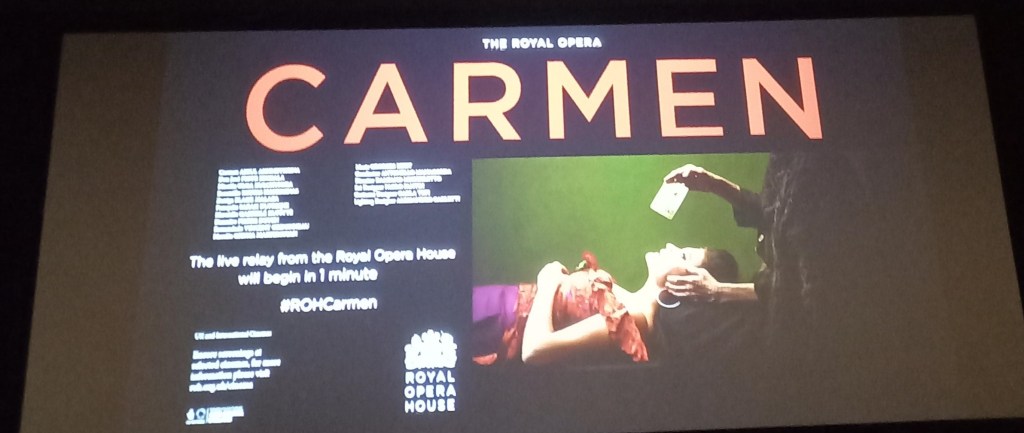
Conductor, Antonello Manacorda; Carmen, Aigul Akhmetshina; Don José, Piotr Beczala; Escamillo, Kostas Smoriginas; Micaëla, Olga Kulchynska; Zuniga, Blaise Malaba; Frasquita, Sarah Dufresne; Mercédès, Gabrielė Kupšytė; Royal Opera Chorus And Orchestra; Director, Damiano Michieletto; Set Designer, Paolo Fantin; Costume Designer; Carla Teti; Lighting Designer, Alessandro Carletti
I travelled to this screening in a rather gloomy frame of mind: ‘planned engineering works’ meant there were no trains to Sheffield, the car wasn’t sufficiently charged to get me there, and the last bus left Sheffield at 21.22. I knew therefore I could only see the first half and a bit of this new Carmen – I saw in the end the first 60%. Also, I had received the previous day the booklet of the new ROHCG season which looked pretty dire – given the budget cuts they were clearly putting on lots of crowd pleasers, and, left to my own devices, I could only see 5 productions I would really want to go to – the new Walkure, the new Semele, the new Turnage opera ‘Festen’, the Tobias Kratzer production of Fidelio, and a double Bernstein bill at the Linbury. I’ll probably go to a few others as dress rehearsals – eg the new Onegin.
I got to know Carmen in the 70’s in the old Coliseum production, initially conducted by Mackerras, and I have only ever seen one since – the 2019 Barry Kosky one, of which I remember little now except for the steps and the gorilla……..Damiano Michieletto directed the current ROHCG Cav & Pag, and there are several similarities between that and this new Carmen. Both involve a revolving central box which can be turned to represent both inside and outside scenes, both have excellent personen-regie with much detailed work with the main singers to create a real sense of interaction and response. Cav & Pag’s direction also included a lot of work with the chorus to create it as almost a set of quite different individuals, not a stylised group – this was less in evidence in Carmen. In both cases the setting is 60’s / 70’s of the 20th century, and the general appearance of costumes and sets is bright and colourful – lots of reds, greens, blues and pinks. Michieletto’s big idea is to have Don Jose’s mother on the stage as a gloomy menacing presence, representing the forces of conservatism and sobriety against which Carmen so effectively positions herself, and this, I think, works well, particularly when the heavy brooding 5 note fate melody is played. There’s evidence of careful thought at every stage about how all the major characters move, how they react to each other, and how they dress – Micaela for instance is very much of one mind with Don Jose’s mum, and wears owlish glasses and conservative clothes (however at the end of the day, it has to be the singers themselves who have to realise on the stage the director’s guidance, and there was some variable practice here). The smuggling gang was brilliantly realised as were the characters of Frasquite and Mercedes.
The conducting didn’t to me seem to rise much above the routine, and I didn’t get the sense of springy rhythms that a Pappano would have brought. Not for the first time, I asked myself why someone from the UK would not have been a better choice of conductor. Manacorda drove the music hard and this was probably for the best – it complemented the sense of a gripping story being unfolded by the director.
Of the singers – well, Aigul Akhmetshina was quite extraordinary, particularly when seeing her close up. I have rarely if ever seen a singer so fiercely engaged in a part – every facial nuance, every movement, was meaningful and complemented/added to what the singing and orchestra were offering, giving us ever richer and clearer insights into Carmen’s character. She’s only 28 – if she can immerse herself in other roles in the same way, she has a sensational career before her. I didn’t know quite what to make of Beczala – he has a fine tenor voice, can spin a line beautifully, can clearly rise over the orchestra thrillingly, and his ‘flower song’ was very well done. But as an actor he seemed a bit stiff and unengaged. Of course, that could be, quite legitimately, his view of Don Jose, and fair enough, then – but I sometimes felt almost as though he didn’t quite know what to do with the demonic energy radiating out of every pore from Akhmetshina. I have heard more sensitive singing of Micaela’s beautiful Act 1 aria than Olga Kulchynska’s, but overall she was very convincing in the role. The chorus, were not that impressive on stage – their actions and expressions tended towards the routine, and credibility suffered from there being too many middle-aged Anglo-Saxon faces to be seen to be a small-town Spanish group of citizens They were also not very incisive or together in their singing in Act 1. The children were well-drilled and funny at first, but became a little arch and irritating after a while.
I would have liked to have stayed longer, but I was there long enough to realise how extraordinary Akhmetshina is in the title role
 John's musical journey