Conductor: Johannes Fritzsch, Director, Josef E. Köpplinger, Stage design Walter Vogelweider, Costumes Dagmar Morell, Choreography Ricarda Regina Ludigkeit, Lighting Fabio Antoci. Cast: Sarastro, Dimitry Ivashchenko; Tamino, Joseph Dennis; Queen of the Night, Aleksandra Olczyk; Pamina, Elbenita Kajtazi; Papageno, Michael Nagl; First Lady, Roxana Incontrera; Second Lady, Sabine Brohm; Third Lady, Michal Doron; Monostatos, Simeon Esper; Speaker, Martin-Jan Nijhof; Papagena, Christiane Hossfeld
My journey to Dresden this time was surprisingly uneventful, given that my previous visit to Germany in November was a bit of a nightmare; DB strikes turned what should have been a 14 hour journey into a 27 hour one to Berlin. I arrived in Dresden this time to the minute on the timetable, after a 14-and-a-half-hour journey from London, covering some of the beautiful Saxon countryside from Eisenach to Erfurt as I travelled. On the morning of this performance, I walked around the old town in Dresden, wandered through some of the large number of Baroque buildings there, and had a very nice waldfruchtcrepe in lieu of lunch. Most of the singers in this performance were new to me, but I think I have heard both Michael Nagl and Aleksandra Olczyk before in these roles at ROHCG
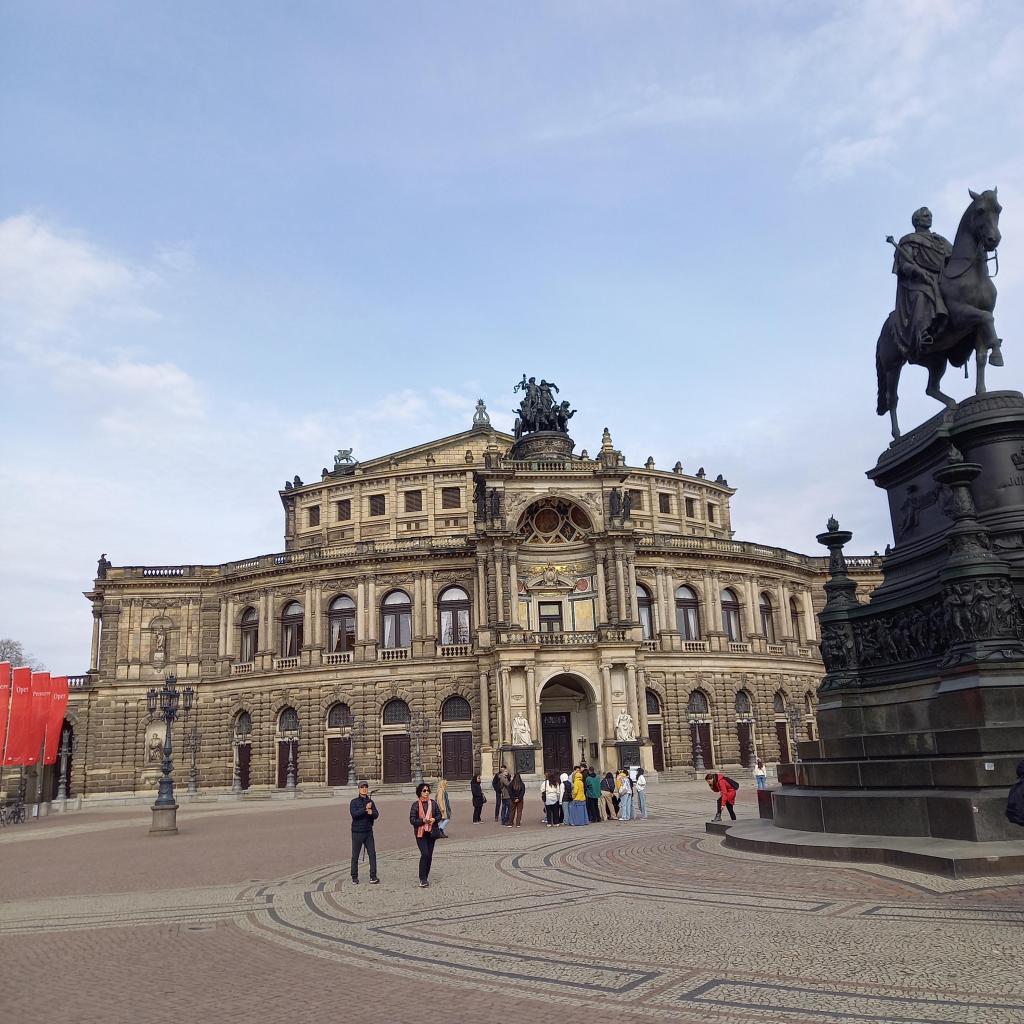
It was a great pleasure to hear this work in the Semperoper – it has beautiful acoustics, which support the singers in giving them a bright forward sound, and which, despite the wide shallow pit, allows them to soar over the orchestra without straining their voices, while at the same time giving that orchestra a warm but clear sound (though we’ll see how the acoustics cope with the performance tomorrow) . The fact that the orchestra is the Dresden Staatskappele in another guise of course helps too – some wonderfully refined playing…..
The work has I think been deliberately chosen to be scheduled at the same time as the run of the new Die Frau ohne Schatten production – two fairy tale operas together, and there is indeed a talk in German on that issue. But I suspect the audience was probably different to that of the following evening – there seemed to be lots of people taking pictures of themselves in the opera house, and groups waving to each other across the auditorium. The audience felt a bit restrained early on, as though it was unsure how to react, but got more into things in Act 2, with more applause and laughter.
The opera begins and ends, and has for the most of the interval sitting in front of the curtain a boy – maybe 12 – with a flute, dressed like a young Tamino. Is this meant to suggest that ‘it’s all a dream’ – a rather tired idea if so? Because of what happens at the end, I thought maybe that the boy is meant to be a Rousseau-like character, emphasising that aspect of the Enlightenment which valued ‘back to nature’, ‘the natural’, the cult of feeling, as against some of the focus on form and wit in the earlier 18th century.
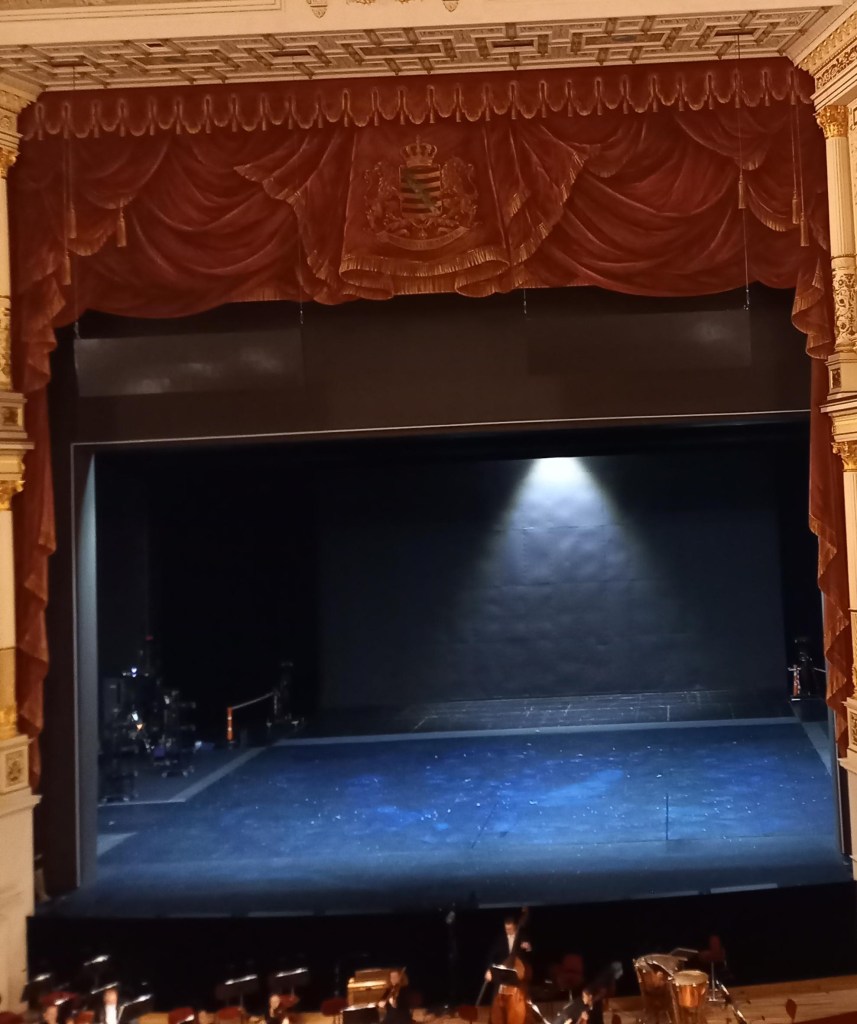
The set is a bare main stage, with blacked out sides and a large video screen at the rear. There is a profusion of video images – sun, moon, trees, leaves, and of course water and fire for the trials. They are attractive to look at and don’t get in the way. There are some splendid props and dressed up actors – particularly the ostrich when Tamino is playing his flute, and the two giant puppet guards during the trials (why the latter?). There is a snake at the beginning, handled, as in some other productions, like a Chinese New Year dragon with men carrying different parts, and a nice flying cart for the boys. Thus the pantomime element was well catered for and clearly pleased the audience. Rather more obscurely Sorastro’s temple seems to be well-equipped with fluorescent lights which frame both the proscenium and also a cage where Tamino and Papageno have their early trials. The fluorescent lights go alongside a screen with three words on it which came down at intervals in the temple scenes– Nature, Wisdom and something else I couldn’t translate. Tamino’s flute is also fluorescent – a bit like a light sabre, as are Papageno’s bells. Costumes were mainly modern, but with 18 century ball gowns for the three ladies and the Queen of the Night, and a bizarre Afro-like pink wig for Pamina – Papagena has a greenish similar one. The Three Boys have curious pointy hats and shorts.
The director’s Big Idea is that, at the end, Tamino and Pamina shed their newly acquired temple gear and run off together (like the Berlin Meistersinger I saw in November). This fits in with the Rousseau idea and obviously gets round the problem of Sorastro’s misogyny and general over-bearingness – but, like the Berlin Meistersinger, makes me uneasy in that it also negates a lot of the good aspects of Sorastro’s temple. As I’ve said before, what I’d really like to see is Sorastro having a real change of heart on stage about women, but that wasn’t there in this production. They and the two priests did ‘offer the hand of friendship’ to the Queen of the Night and her three ladies, but this was indignantly rejected.
All in all, an effective enough production and with more of a sense of zaniness than some, mostly in good taste and good fun, but not really tackling some of the more difficult aspects of the work – in fact, running away from them, you might say…..
The biggest cheers of the evening, cast-wise, were for the Queen of the Night, Papageno, and , to a lesser extent, Pamina. As usual, audiences tend to get things right and I was in agreement, though Sarastro was very good too, I thought. Aleksandra Olczyk was superb as the Queen of the Night – note perfect and she made it sound easy! Michael Nagl as Papageno as a genial presence – he didn’t ham the role up but projected warmth and humanity, and had a rich baritone voice as well. Dimitry Ivashchenko as Sarastro I thought had a very fine voice. Elbenita Kajtazi as Pamina wasn’t as memorable as say Lucy Crowe 5 years ago at ENO but she projected the words well, varied her tone and her ‘Ich fuhls’ was very good in its musicality. Joseph Dennis as Tamino I thought had almost too large a voice for the role – it didn’t really sound ‘Mozartian’ in the way Stuart Burrows, for instance, used to – and occasionally his voice sounded a bit frayed. But – really – all the cast were very good and I would happily have heard any of them again in their roles. Johannes Fritsch is a Conductor Laureate at Dresden and has pursued a flourishing career in Australia for the last 20 years ago. His Mozart was lively but not rushed, with a clear articulation of all the notes and with a real spring to the rhythms.
 John's musical journey