Keri-Lynn Wilson, Conductor; David Alden, Director; Charles Edwards, Set Designer; Jon Morrel, Costume Designer; Adam Silverman, Original Lighting Designer. Jennifer Davis, Jenufa; Susan Bullock, Kostelnicka; Richard Trey Smagur, Laca; John Findon, Steva; Fiona Kimm, Grandmother; Darren Jeffery, Mill Foreman; Freddie Tong, Mayor; Madeleine Shaw, Mayor’s Wife
It was fascinating to experience a theatrical version of this work so soon after Rattle’s January performance. While the LSO played superbly, there’s no doubt that seeing this live in the theatre adds a whole extra dimension to the experience, even if this performance took until after the interval to catch fire – but when it did so was gripping to watch and listen to.
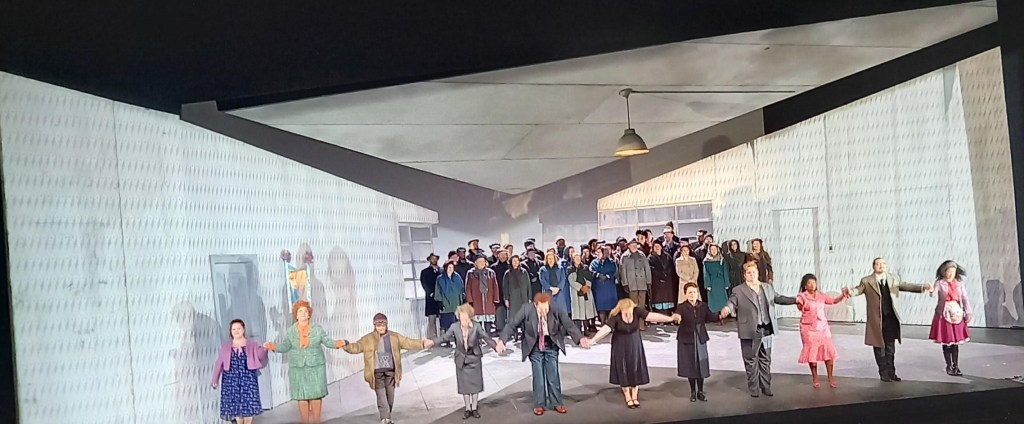
The setting was Eastern Europe Soviet-bloc era – shabby rooms, rectangular multi panelled windows and drab street-fronts in murky greens, greys and off whites, appropriately claustrophobic. There was a white screen at the back in Act 1, behind closed windows in Acts 2 and 3. The window panels rattle violently with the storm as the Kostelnicka returns from killing the baby in Act 2, and the angry crowd bursts through them violently in Act 3 in response to news of the dead baby – both very effective coups de theatres. There was very effective use of sidelighting in Act 2 and 3 to create a sense of menace. Costumes were 1960s or so with a splendid leather jacket and motor bike for Steva.
As indicated, there was some lack of tension in Act 1 – I am not sure what the problem was, but it was somewhere between or composed of the fact that Laca’s outburst at the end of Act 1 was less violent than it should have been, Jenufa seemed a bit characterless at first, maybe the orchestra was a bit understated and lacking in dynamism, and there was some distinct lack of coordination and precision among chorus and orchestra in the first peasant songs – also the set itself seemed not to “do’ much – it provided a space but not much more. Things improved massively in Act Two which was gripping. Jenufa was very moving as she realised her baby was dead, the set and lighting fully supported the sense of stark horror and darkness in what was happening, and the Kostelnicka was compelling in all she did. Laca was very believable in his mood swings, and seemed much, much less of a cipher than he had done in Act 1. The tension continued at the same level in Act 3, with some superb playing by the orchestra, particularly at the end . Perhaps at the end of the day the recent ROH production is better in terms of its set and direction, but this was still a compelling performance, made more so by being sung in English, which sometimes adds a visceral impact there’s no substitute for.
And ENO had got an excellent cast together for this performance. Like Katarina Dalyman in the Rattle concert performance, Susan Bullock is an ex-Brunnhilde, and it shows in the declamatory power she can bring to bear on the Kostelnicka’s agony after she murders the baby, but she was also capable of singing beautifully quietly as well. Jennifer Davis impressed me as Elsa in Lohengin in Berlin in November (as well as at ROH 2 years ago) but then I found her acting a bit dull, though she was excellent musically. Here she seemed to possess the role in a much fuller way – she projects very easily but powerfully a very ordinary young woman who gradually allows herself to get into a tragic situation and both has the spiritual and emotional strength to cope with it and then rise above it, with compassion for her murdering mother. She was very moving. Both Richard Trey Smagur, an American tenor, as Laca, and, pleasingly, John Findon, given another big part as Steva, are very big men, which helps with their stage presence. John Findon was perhaps a bit straight-faced and unrelaxed as Steva (by comparison with Nicky Spence, say) but sung the role very well indeed, as did Trey Snagur. As you would hope with ENO, there were all sorts of excellent singers in the smaller roles, each contributing their part well – not a weak link there. Quite why Keri-Lynn Wilson, a US conductor, was there, I am not sure – she did, as I say above, do a good job and galvanised the orchestra in Acts 2 and 3, but, at the risk of sounding grumpy, there are many British conductors who could conduct this work just as effectively – Leo Hussain, Alpesh Chauhan, and many others – and probably at less cost
 John's musical journey