Britten Sinfonia, Guy Johnston cello: Beethoven Grosse Fuge Op.133; Bartók Divertimento for String Orchestra; Tavener The Protecting Veil
This, by contrast to the previous concert, did not seem to be a clear model of coherent programming. Other than the fact that all the works are focused on the use of a string chamber orchestra, I failed to find any clear connections between the pieces, though maybe the point is the difference between the knotty, struggling, ‘difficult’ pieces in the first half and the serenity of the second half. The Britten Sinfonia of course was notoriously savaged by Arts Council cuts in November 2022, despite being the most prominent orchestra in the East of England, so I felt duty-bound to go along to support the Manchester leg of their 2024 tour, despite the slight oddness of the programming.
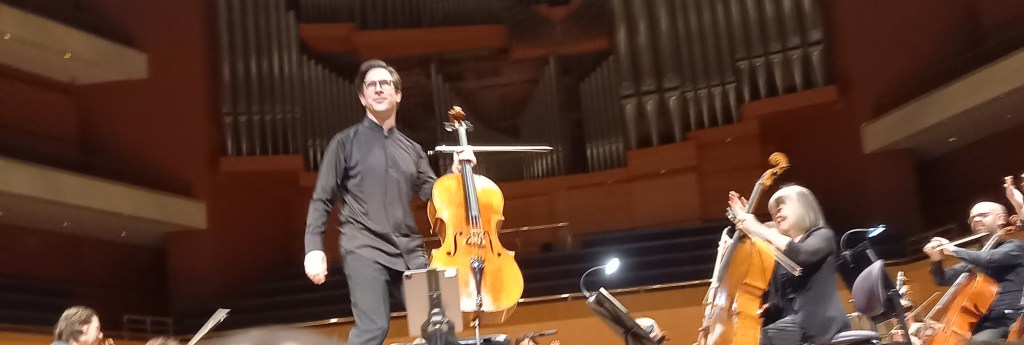
The Britten Sinfonia sounded a very fine band, but I thought their self-presentation to the audience needed a bit of attention. It’s good that they don’t have all the flummery of conductors to deal with and they made creative use of lighting, particularly in the Tavener piece, but I felt a bit of a spoken introduction would have helped before each work – certainly with the Beethoven and Bartok. Guy Johnston did a great interview in the Guardian about Tavener and I am sure a way might have been found to let him talk about his clear love for the work without destroying the aura the Sinfonia wanted to create at the beginning of The Protecting Veil.
I felt the Beethoven performance lacked something. It may be that the Grosse Fugue just sounds more visceral, has greater instrumental attack, when played by a quartet. Somehow this performance sounded a bit soggy, not quite as sharp as it should have been, and as though it needed a conductor to bring coherence to the relationship between the quieter passages and the frenzied fugal elements.
The Divertimento for String Orchestra is Bartók’s last work composed just before he fled Hungary and emigrated to the United States at the outbreak of World War II. It’s in three movements – an opening allegro with gypsy music influences, a molto adagio, and a finale that’s very quick. It uses the concerto grosso format, as I wrote on this blog when I last heard it in a dynamic performance by the LSO and Tony Pappano in October. The Sinfonia’s Bartok I thought was superb. The slow movement was utterly gripping in its menace, resignation and drama and the finale had all the energy and thrust needed. The first movement was also extremely well played, though as with the Pappano performance I found myself getting lost halfway through this movement. The Sinfonia sounded utterly together and at ease without a formal conductor.
Tavener is an interestingly wayward figure in the UK’s classical music history of the past 70 years. 20 or 30 years ago there would have been one or two first performances a year of large scale orchestral/ choral works by him, with long Greek or latterly Sanskrit titles. Whereas Arvo Part, another key figure in the field of holy minimalism, seems still quite widely played – possibly because his works vary more in nature, instrumentation and length – since Tavener’s death I have come across few instances of his works being performed, outside some choral classics – ‘ The Lamb’, ‘Song for Athene’ and so forth. Maybe there is going to be a massive re-evaluation of his output at some point, or maybe most of it will slide gently into oblivion. The Protecting Veil as a quasi-cello concerto has obvious champions in the various cellists who have put it in their repertoire and perhaps therefore stands more chance than most of his works of surviving. Having said which, there was a pretty full audience for this concert, and I got the sense that it was slightly different to the usual crowd who would turn up to BH concerts – so maybe there is a big Tavener fan club out there waiting for more performances of his works…….
As Tavener himself observed, The Protecting Veil is a sort of lyric ikon and stands as much as an aid to meditation as a structured piece of music in its own right. It has a glorious signature melody and some wonderful orchestration. It is utterly itself and without apology – and that must be a virtue! Maybe it slightly overstays its welcome, but I was impressed listening to it again (though I have never heard it live – I have a CD of it somewhere but haven’t listened to it for years). Guy Johnston played it superbly.
I’m glad I went to this concert!
 John's musical journey