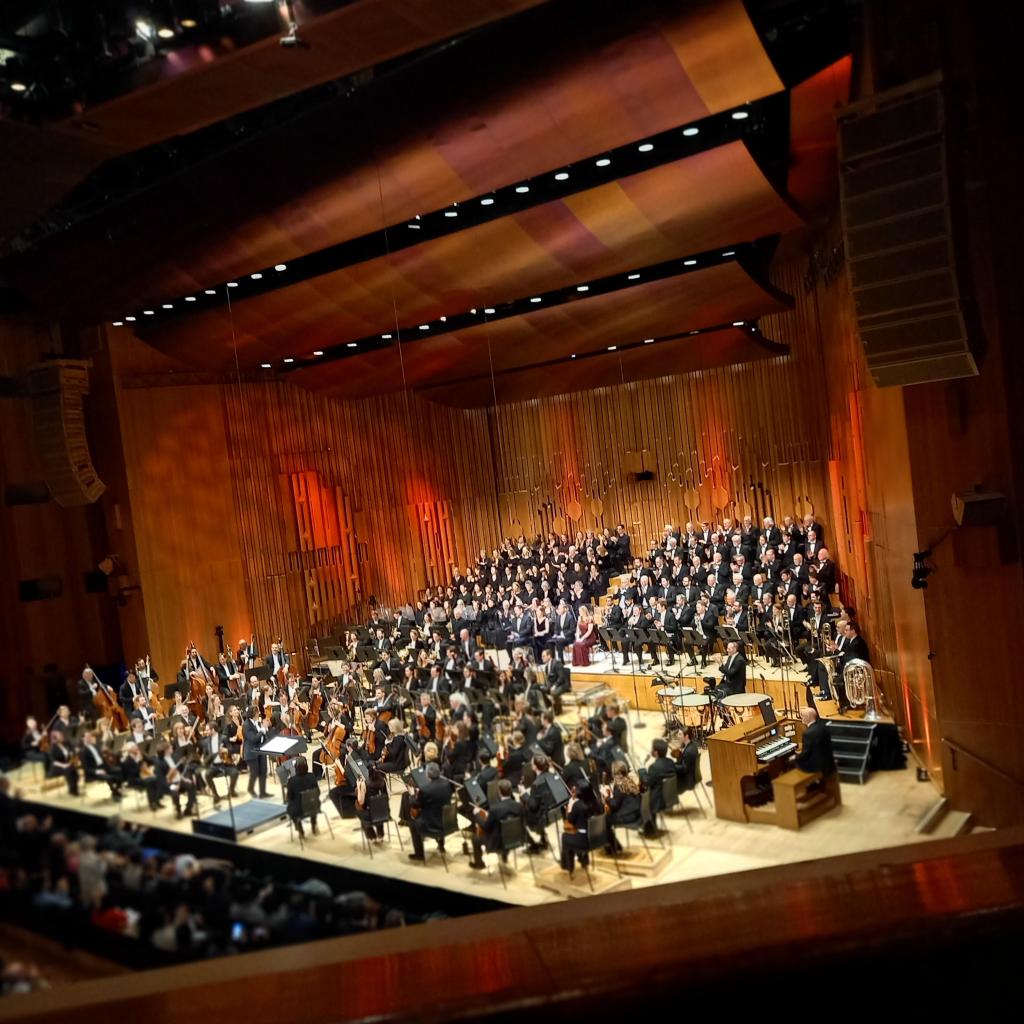
Anton Bruckner Symphony No 9 (Ed Benjamin-Gunnar Cohrs); Te Deum (Ed Ernst Herttrich 2015). Performers – London Symphony Orchestra and Chorus, Nathalie Stutzmann, conductor; Lucy Crowe soprano; Anna Stéphany mezzo-soprano; Robin Tritschler tenor; Alexander Tsymbalyuk bass
I was hoping to have gone to a very interesting Halle concert before going down to London for this concert– a celebration of Steve Reich with Colin Currie, the percussionist, as conductor, and members of the Halle Orchestra – but sadly local trains were in a state of complete collapse and I was unable to get to it. So it’s almost two weeks since I have been to anything musical.
I have heard some fine performances live of Bruckner 9 by Haitink and Blomstedt. I am very pleased I found, after a lot of searching, a BBC SO orchestra recording of the work with Reggie Goodall conducting, which is a wonderful performance from the late ‘60’s. And I have a fine recording by Furtwangler. But I have often fretted about the issue of the missing 4th movement, and the curious reluctance of conductors and orchestras to play and promote the various scholarly completions of the work. Bruckner finished approximately 17 minutes of the last movement in full score, not just sketches, and there are several more minutes in sketch or piano form. The main problem is that the coda is missing so scholars must work out how this would sound, based upon the codas of, particularly, the 7th and the 8th symphonies – maybe also the 5th as well. Their conclusions are – from the versions I’ve heard – sometimes startlingly different. Nikolaus Harnoncourt once gave a lecture/concert of the Finale fragments that was recorded by RCA/BMG and can also be found on https://www.youtube.com/watch?v=1fBJPhKezGc. This is a very interesting 35 mins or so which gives a very real sense of how much there is of a completed finale, and how different this is, for scholars, as a completion exercise, to something like Anthony Payne’s reconstruction of Elgar’s Third Symphony. Harnoncourt also makes the point that there may be pages of the manuscript score still extant, which lie hidden in someone’s attic, having been taken away by friends and enthusiasts after Bruckner died, as mementos….! It seems strange to me – given that there are several completed versions by scholars (none of course accepted by the entirety of the Bruckner scholarly community, as the subject is a wonderful academic playground) – that we don’t hear performances of all four movements (perhaps with a pause before the finale to allow those who want to to leave). There are a range of completed versions – eg the version on https://www.youtube.com/watch?v=gVoNyv5bfac (Sébastien Letocart), as well as the DG Rattle/BPO recording worked on by a group of European scholars and released in 2012, and the version by William Carrigan, of which there is a recording, on the Chandos label, by Yoav Talmi conducting the Oslo Philharmonic, quite different at times to the Rattle version (and with a track of the original sketches as well as the Carrigan version of the 4th movement). There are others. Bruckner’s famous death-bed recommendation that the Te Deum be substituted for the ‘unfinished’ 4th movement of the 9th sounds very like some of the other things he agreed to under duress and doesn’t wholly make sense. The Te Deum dates from 10 years earlier and is a straightforward confident affair, very different from the darkness and angst of the 9th symphony.
Anyway, there we are…….a concert with the completed three movements of the symphony and the Te Deum. Natalie Stultzmann I haven’t heard before conducting live, though I enjoyed listening to a broadcast of her Tannhauser at Bayreuth last year, which was much – praised. I have just got tickets to hear her conduct Tannhauser at Bayreuth this year (along with the newish production of Parsifal and the new Tristan).
Stutzmann had a clear beat and was very much controlling her large forces (9 horns, 4 trumpets and trombones etc) effectively. There were clear distinctions between the different gradations of volume. This was certainly not the murky slow Bruckner of some but clearer and harsher. That’s not to say that where appropriate themes weren’t warmly shaped and phrased -eg the second subjects of the first and third movements or the second theme of the Trio. Nor was Stutzmann on the whole taking things too fast, though I did think that the Scherzo could have been more menacing with a slightly slower tempo. And there was real passion in the opening of the third movement – very Mahlerian…..What this performance gave me, through the clarity, through the very fine LSO playing, was a real sense of Bruckner’s precarious mental health while writing this work. A neighbour, who used to be a horn player in London orchestras in the 60s and 70s, was telling me about what he thought was the most chilling part of the work – the strange high trumpet note that sounds quietly over the reprise of the scherzo – he thought it was one of the most agonising moments in all music (and it was superbly realised in this performance). The sheer oddity, the menace, the strangeness of the harmonies came over very clearly, particularly in the third movement which I thought was very finely shaped – everything led inexorably to that terrible climax. Interestingly the final tender string melody, which is normally shaped in a smoothly consoling way was phrased as a series of stabbing notes. Whether that was something to do with the textual edition used, or vibrato-less playing, I’m not sure, but it was a chillingly resigned end, like a clock ticking – in a sense making the need to hear the proper finale the more pressing. On that particular issue it is interesting how one or two melodies in the first three movements prefigure Bruckner’s wonderful chorale melody in the finale.
Some people have said that the reason the finale was never finished was a failure of Bruckner’s imagination- that he no longer had it in him to write the great hymn of praise he envisaged. I have to say the version Rattle recorded- by the group of scholars which includes the late Benjamin-Gunnar Cohrs, who also edited the version of the three movements played by Stutzmann – is convincing to my mind even though the coda is perhaps too short.
Whatever the answer, the Te Deum isn’t it. The performance was fine – the beginning and end even thrilling but this is a totally different sound world to the 9th symphony and offers no real resolution to the bleakness of that work.
All in all then I found this to be a fine performance. Using my now familiar three markers for Bruckner, this performance did Schubert and Wagner very well but missed some of the God element. I wonder why – unless I missed it- Stutzmann didn’t give the trumpet section a solo bow at the end – maybe they were a bit underpowered (unusually for the LSO). Or maybe she just forgot.
I’ll look forward to hearing Stutzmann conduct Tannhauser this summer. And onto the Big Bruckner Weekend at the beginning of March in Gateshead.
 John's musical journey