John Storgårds, conductor; Christian Tetzlaff violin. Prokofiev Cinderella, Suite No. 2, Op. 108, Thomas Adès Violin Concerto, ‘Concentric Paths’; Shostakovich Symphony No. 1 in F minor
This looked in prospect to be a fascinating programme: – a very competent conductor, a famous violinist, a Thomas Ades piece I hadn’t heard before, and a chance to get to grips, with the focus of a live performance, with the Shostakovich piece, which I have never quite got my head around. All this, plus some of the Cinderella music (I had previously heard Gergiev and the LSO performing the complete ballet at the Proms about 12 or 13 years ago)!
And indeed this was a very enjoyable concert of what was for me fairly or completely unknown music. I noticed Simon Webb, head of BBC orchestras in the audience, looking a bit furtive, as well he might given the excoriating and maybe unfair criticism regularly hurled at him by Norman Lebrecht (BBC executive ‘owns mistake’ of killing ensembles – Slippedisc) and others. The hall was quite full, young, and appreciative – lots of University and RNCM / Cheethams students. Perhaps some had come to hear Christian Tetzlaff. The programming was a bit of a mystery – obviously Prokofiev and Shostakovich have connections, but the connection of either’s pieces with Ades was unclear. Perhaps the truth is that these are three works with quite awkward timings which just fitted together as a satisfying programme (which it was).
Cinderella was composed between 1940 and 1944, with Prokofiev breaking off in the middle to write his opera War and Peace. The premiere of Cinderella was in November, 1945, at the Bolshoi Theatre and the suites from the ballet were put together by the composer in 1946. It was very well played by the orchestra, with some particularly taut playing by the strings in the final Galop. Truth to tell, this Suite doesn’t really cover the well-known parts of the work (which presumably are in Suite 1) and while enjoyable I found my mind drifting at times. Also, given that these are excerpts which cover specific parts of the story, albeit in narrative order, there wasn’t really a feeling of progression or an inner musical narrative.
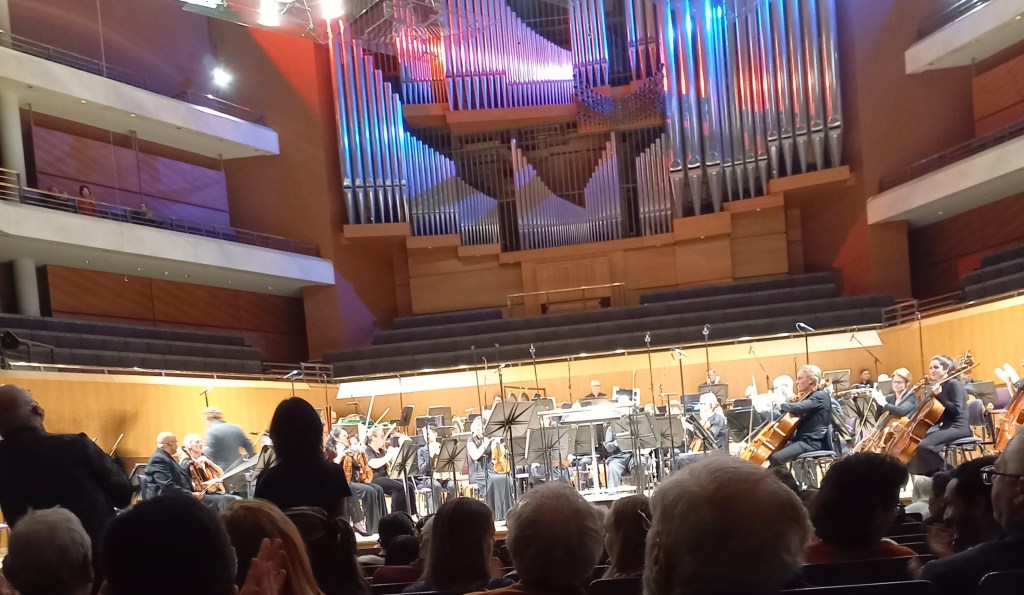
Concentric Paths is the subtitle of Adès’ concerto for violin and chamber orchestra. It was premiered in 2005 and is in three movements, Rings, Paths and Rounds. About 20 minutes long, I found it a gripping piece and must find a recording of it. I wished I’d listened to it beforehand on Youtube. Ades’ music somehow immediately gets to me – there’s always some sense of a narrative, of progression, of emotions which the music embodies. In the case of this work (and here I am following on from Tom Service’s programme notes) there’s perhaps a connection with the much more recent Dante ballet, or maybe the music of the spheres – the first movement does seem to portray an ethereal sort of state, with very high solo violin sounds, while the second is a lot darker, more hellish, with stabbing chords. The third movement seems to offer a resolution of these states of mind. Tetzlaff’s strong, sweet playing was, I thought, remarkable, and he got (see photo below) a standing ovation from at least some members of the audience.
Perhaps because of the uncomfortably slightly short length of the Shostakovich symphony for a complete second half work, the orchestra played before it a short and simple but enjoyable Scherzo composed when the composer was only 17. I was thrilled to be finding the Shostakovich symphony easier to follow than I have found listening to it on disc or on the radio – I have never heard it live before. It is a piece absolutely bursting with ideas, with sudden switches of mood and false starts by a prodigiously gifted young composer who wrote it as his end-of-Conservatoire show piece. Again, I must play my recording of it to understand it more. But I was very much taken with it, and it seems to demonstrate that time, not only of Shostakovich as a young man, but also of Russia’s intellectual ferment and experiment in the early 1920’swhen anything seemed possible, before the Soviet heavy hand got a grip. There are influences here certainly – of early Stravinsky and Prokofiev – but also it shows Shostakovich’s own developed voice coming through strongly.
Throughout the evening I was again impressed by John Storgard’s conducting – he is a very dependable figure on the podium
Tetzlaff leaving the stage with audience members giving standing ovation
 John's musical journey