Conductor, Daniele Callegari; Abigaille, Liudmyla Monastyrska; Fenena, Maria Barakova; Ismaele, Seokjong Baek; Nabucco, George Gagnidze; Zaccaria, Dmitry Belosselskiy. Direction, Elijah Moshinsky.
Nabucco is one of those works I would probably never stir myself to see live (certainly haven’t done so hitherto…), and I needed a bit of internal debate and persuasion to go to a live screening of it from the Met in Manchester (the cinema which used to show the Met’s cinematic offerings in Sheffield is no longer doing so, so it’s much more of a trek). Luckily ROHCG screenings in Sheffield are continuing, and none of the other Met showings this season attract me (except maybe La Rondine, but I have just seen that live…….. )
Having been immersing myself in Jane Glover’s splendid book ‘Handel in London’ over the last week (a Christmas present) I casually wondered how Handel would have dealt with the subject of Nebuchadnezzar in an oratorio. One similarity surprisingly in both Handel’s oratorios and Nabucco is the extensive use of the chorus – the conductor reckoned at least half of the music was choral. I felt that maybe Handel was better served by creating the sound world of his later oratorios using the English cathedral choral tradition than Verdi was using the opera chorus traditions of the early 19th century Italian theatre….quite a difference really….
Anyway… when the overture began I realised I once had – probably still have – a record of it which I must have last played about 45 years ago and that I remembered its tunes, all of which are used in the opera for arias or choruses.. That put me at my ease – my feeling about listening to and seeing Verdi is that it is a race between my enjoyment of the vocal pyrotechnics and the sheer energy of the music, on the one hand, as against my dismay at the ridiculousness of many of the plots and the mundaneness of much of the music, on the other, as to which gets the upper hand. With this opera the former just about triumphed over the latter, though only Nabucco and Abigaille have anything but cardboard cut-out parts, and several strands of narrative seem to have been forgotten about after their introduction (the relationship between Ismaele and Fenena, for instance). Overall I quite enjoyed seeing this – though I think once is enough….
My enjoyment was not helped by the production. The late Elijah Moshinsky I rated highly in the few ROHCG productions of his I saw. This one was very much reduced in impact by the massive revolving set – part temple of Baal, part Jerusalem temple, with lots of crags, steps and ledges for the chorus to perch on. This was problematic because:
- It gave the chorus too little space to move around meaningfully in
- It allowed far too much worry (at least in me) about whether anyone was going to stumble on the precipitous steps over a gown or scabbard
- It confused, despite its intentions, the spaces which were ‘Hebrew’ and those which were ‘Babylonian’
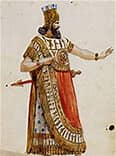
It all seemed rather typical of the Met, and untypical of Moshinsky from the few shows of his I’ve seen. The costumes were also slightly curious - at least for the Hebrews: a sort of Afghan/Eastern Europe mix which looked odd – the Babylonian males were mainly in armour. All in all I wondered what sort of real input had been made by the anonymous individual who must have had a role as the revival director – there was too much semaphore acting and most of the time the singers seemed to do their own thing on stage, rather unimpressively.
The singing however carried the piece! The classiest voice was that of Maria Barakova, who sang most beautifully. I would love to hear her mezzo voice in a bigger role. Liudmyla Monastyrska had some occasional wayward moments, but this is a very difficult part and she has both the range for it (some very low notes as well as the high ones), and the power. She also has the ability to sing quietly to beautiful effect, with a lovely ‘white’ tone. And she looks the part of an imperious princess (not surprisingly she also sings Turandot), though her acting ability lurks just about over the acceptable side of hamming. I thought George Gagnidze also had a very good voice though his general demeanour remained much the same throughout – he never really conveyed the sense of a man either going mad or undergoing a religious conversion. Still, his voice sounded strong throughout. Seokjong Baek did what he could with the unrewarding part of Ismaele. Dmitry Belosselskiy was a disappointment as Zaccaria – his voice was simply too wobbly in his lower register and in general it sounded unfocused. The orchestra sounded idiomaticand energetic, and the chorus was very impressive indeed.

 John's musical journey