Matthew Kofi Waldren conductor; Jack Furness director; Georgia de Grey designer; Ben Ormerod lighting designer. Olivia Swain Mother Spring; Adam Jarman Father Frost; Jessica Hopkins Snow Maiden (Snyegùrochka); Yihui Wang Bobìl-Bakula; Leah McCabe Bobylìkha; Henry Strutt Tsar Byenrendèyi; Alexander Gibb Byermyàta; Sophie Clarke Lyel; Charlotte Baker Kupàva; Matthew Secombe Mizgìr; Nicholas Collins Boggart; William Jowett Màslyenitsa
I can’t remember whether it was in a St Petersburg or Moscow gallery, but the last time I was in Russia (2018) I saw a wonderful display of first performance stage models and costumes of various Rimsky-Korsakov operas, as part of a broader theme looking at the impact of Russian nationalism on the arts. I thought to myself at the time – I have never seen a Rimsky-Korsakov opera…..I had hoped to see ETO’s The Golden Cockerel last year, but that was stymied by Covid. Here now I’ve finally seen one, much earlier in date than the Golden Cockerel – c.1881.
It’s an opera in four acts with a prologue. The libretto is by the composer, and is based on the play by Alexander Ostrovsky (which had premiered in 1873 with incidental music by Tchaikovsky). There is a shortish symphonic suite of some numbers from the work which come up from time to time in the concert hall – I have a recording of it by Ansermet – so some of the arias and choruses in the work I found very recognisable.
It is interesting to reflect how this work might have sounded and looked with a professional company and an innovative director. Clearly the RNCM’s production was principally about giving as many opportunities as possible for its young singers and orchestral players and getting them to perform to as high a standard as they can achieve. In a sense making the best sense of the work is secondary to that fundamental aim. The Snow Maiden I found to be one of those works which needs a lot of help from a director and stage designer if it is to work.
The basic storyline is easily told – the Snow Maiden’s desire is to leave the icy grip of her parents, Father Frost and Mother Spring, and go into the human world. However, she finds she cannot love anyone. She meets two boys, Lyel (curiously a trouser role) and Mizgir. The latter has married Kupava but becomes smitten with the Snow Maiden. Kupava is furious and seeks the tsar to address her marital problems. The Tsar declares that whoever successfully woos Snow Maiden will win both her and a royal reward. Although the crowd around the Tsar present Lyel as the likely candidate, Mizgir swears that he will win the Snow Maiden’s heart. Lyel eventually goes off with Kupava, and, seeing their love, the Snow Maiden herself finally wishes to love. However, when she declares her love for Mizgir, who still reciprocates it, it becomes clear that she will die. The power to love is the source of her demise and she melts. The inconsolable Mizgir drowns himself in the lake.
The work has a delightful sequence of Russian folk tunes and quasi folk tunes, together with grand ceremonial processions and dances – it is easy to listen to, as much of Rimsky’s orchestral music is. The problem is that the opera is – in this production, anyway – very bland and hopelessly ‘operatic’ in all the bad ways opera can be: characters who aren’t fully delineated, constant emoting that seems superficial, and a story that isn’t relatable to by a modern audience, and quite long for its subject matter (the first half was Wagnerian in length – nearly 2 hours). Quite how a director might create something more engaging I’m not quite sure. At one end you could perhaps envisage a ‘magical’ production with a lavish set and lots of theatrical tricks; at the other some sort of modern setting – a domestic drama, possibly of the Soviet era (Stalin as Tsar?). One thing which was good here was the translation (the work was sung in English), which had no infelicities and well aligned to the music.
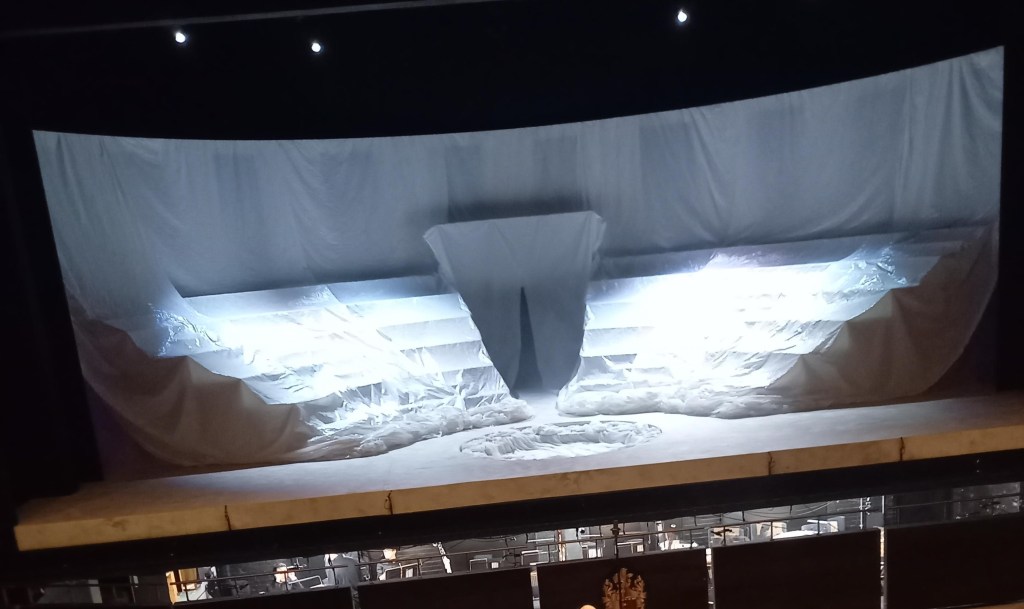
The basic set in the RNCM production didn’t change from act to act and was as in the photo below, a raised semi-circle of steps, a central entrance and a pool downstage – changes of place were signalled by different lighting. Costumes for the most part seemed traditional folky Russian (with a few quirks like the Tsar’s bodyguards wearing sun glasses). The main characters were clearly thinking through their individual characters, and their reactions to each other, and so interactions between the principals on stage worked well – credit to the director for this! The chorus – maybe because of the steps – seemed much more stationary and not very reactive.
It would be unfair to go into the details of everyone’s performances – there were the outstanding, the good, and the adequate. My outstandings were:
- Chorus and orchestra, singing/playing without hesitation and with confidence, and with more or less no mistakes
- Three singers: I thought Jessica Hopkins was outstanding as the Snow Maiden. She is someone who instinctively knows how to move on stage in a way that makes you watch her. Her voice was able to capture some of the poignance and the tragedy of her role and seemed a very sound instrument – no wobbles or awkward transitions. Her diction was very good. Equally as good was Sophie Clarke as Lyel who had a lovely voice and a good presence on stage. I was also impressed by Charlotte Baker as Kupàva who was a very lively indignant presence, thoroughly convincing in her role.
There had been some sort of reception before this performance and I noted some local dignitaries – a mayor and mayoress with their gold chains – and what were probably local councillors. It’s always a good test in an opera performance to ask yourself the question – what would someone unfamiliar with opera make of a performance you’re at. With the performance of Daphne 3 days earlier, I think someone coming new to opera would have recognised something powerful and engaging, even if they weren’t sure about the idiom In this case, sadly, I felt they wouldn’t have been very encouraged to go on to other operas; they would have felt the worthiness and energy of the young singers as something to be encouraged, but they would have seen (and actually heard) little to make them feel this was a great art form, that it had anything to say to them, and that it could move them at its best in a way no other art form can

 John's musical journey