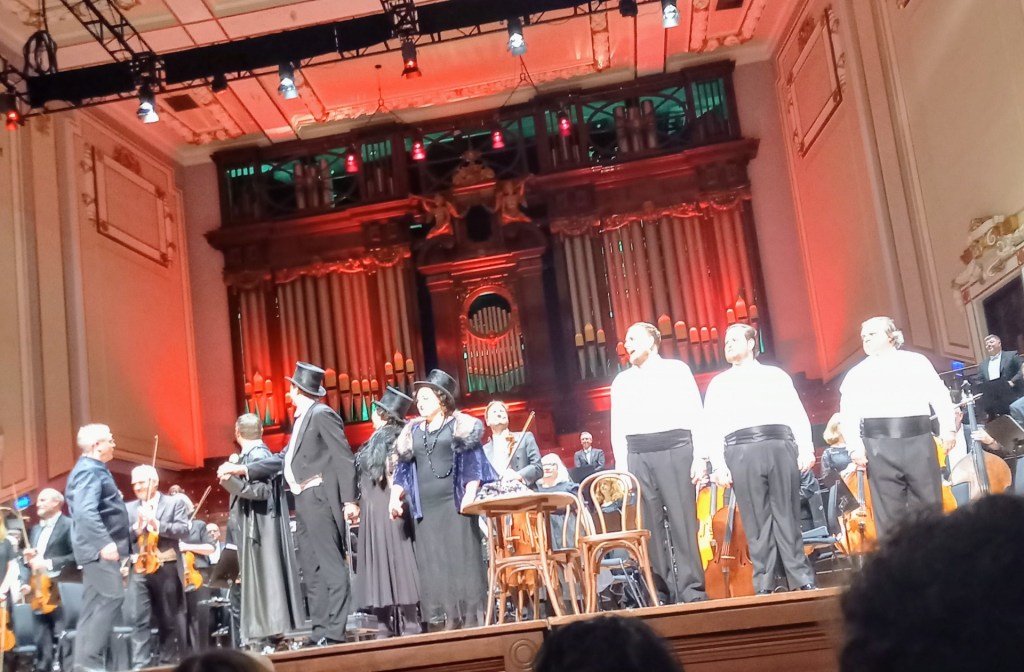
Daphne, Hye-Youn Lee; Leukippos, Shengzhi Ren; Apollo, Brad Cooper; Peneios, Dingle Yandell; Gaea, Claire Barnett-Jones. Conductor, Stuart Stratford; Concert Staging, Emma Jenkins
Daphne is a work I’ve never heard live before and almost certainly I’ll not hear it again in my lifetime. The first performance of the opera took place at the Semperoper in Dresden on 15 October 1938. The libretto is by Josef Gregor, a noted Austrian writer and librarian, who took over the role for a while as Strauss’ ‘go-to’ librettist after Stefan Zweig left Europe, fleeing the Nazis.
I have never seen a Scottish Opera performance before, either, and in fact I was very surprised I made this performance at all (by rail from Sheffield to Edinburgh). The previous evening had seen 24-hour’s worth of rain and 60mph winds. TransPennine Express and LNER trains were scarcely running on the day of the performance, with flooded tracks and entangled overhead wires galore, but my route via Sheffield was unaffected and working perfectly normally. I arrived in a very wet and windy Edinburgh with ample time to spare and walked down the Royal Mile to the Usher Hall – very different to the weather appropriate for an Ancient Greek summer afternoon.
Although it’s always been a work I wanted to hear live, my assumption had been that Daphne would – the final transfiguration music apart – be Strauss perhaps rather on auto-pilot, with, as I have said on other occasions, lots of Straussian tics and repetitions of mottos from Die Frau ohne Schatten, Rosenkavalier etc. Actually, listened to closely within the context of a live performance and a fairly short running time, it seemed to be much more than this – a constant kaleidoscopic stream of complex melody that will only become clearer with my taking the trouble to organise some repeated listening, and which really seems to demand that sort of detailed attention. I was much more swept up by the work than I had expected to be, and felt it had real dramatic drive as well as beauty and orchestral splendour. I loved Daphne’s opening song, ‘Leb Wohl, Du Tag’, as well as her song with the chorus of shepherds – ‘O Bleib Geliebter Tag’
The performance was a ‘staged concert performance’, which essentially meant singers in costume, up to a point, some props and some movement, but no special effects (such as Daphne’s transformation to a tree – not even a few sound effects and a bit of lighting when Zeus gives his thunder-flash). The director takes as her starting point the political context at the time Daphne was written. She sees Apollo as a National Socialist, and dresses him up in full length double-breasted leather coat with jack boots and a pistol to kill Leukippos. Daphne’s mother, sisters and father are representatives of Weimar decadence, complete with cigarette holders and 20’s style costumes. The idea is that Daphne is pursued by these two tendencies in German political and social life of the 20’s and 30’s – and goes into internal exile from both of them by becoming a tree! A further link made by the director – but you wouldn’t have known if you hadn’t read her programme note – is the connecting of Daphne with the non-violent resistance White Rose group whose student leader Sophie Scholl was killed by the Nazis for distributing leaflets. Simple white roses were there throughout the production – one is given by Apollo to Daphne, and each chorus member caresses one in the final scene . I think the correlation of Strauss’ political position and difficulties with Daphne’s movement away from the normal social world makes some sense, but none of this is always very clearly relevant or can be dogmatically applied – for instance Apollo is very contrite and full of shame for his action in killng Leukippos, hardly the sentiment of a Fuhrer-type. I could as easily envisage an environmental interpretation of the work. Anyway, it was serviceable enough as a concept……and it is also the case that, as the programme pointed out, the closing 10 minutes of Daphne had a special meaning for Strauss in his final years. There’s apparently a 1949 film documentary about Strauss called ‘A Life for Music’ where, when asked to play something on the piano from one of his work, he chooses Daphne. The action on stage felt natural and uncomplicated. From Row F in the stalls, though, acting ability varied – the acting stars in terms of physical presence and ability to convince the audience were Apollo, Gaea and Peneios.
The work depends on 5 excellent singers – Daphne, Apollo, Leukippos Gaea and Peneios. In line with the well-known aphorism that Strauss hated tenors, Apollo has perhaps the toughest role of these 5, required to be pinging out top note after top note, often against heavy brass. Brad Cooper has Siegfried in his repertoire and I thought he was an excellent heldentenor, with the virtues and vices of the breed – thus subtlety maybe less emphasised than bright clear notes – there was no sliding upwards to the note! Hye-Youn Lee seemed to be a very good Daphne, again with a bright forward sound. I sometimes felt her words weren’t getting across too clearly and I wouldn’t have said she has the musical sensitivity of, for instance, a Renee Fleming – but she was very good. Her father Dingle Yandell had a really strong bass voice and presence, and got one of the loudest cheers at the end. Claire Barnett-Jones was the calculating mother, who sung with very clear diction and lots of shade and colour in her voice. The Leukippos, Shengzhi Ren, had a thankless task – it’s a stolid role, not much that’s characterful about it, and the performance was indeed, well, stolid, though he gave a strong protest to Apollo. The group of peasants, presumably from Scottish Opera chorus were good, and the orchestral playing – in what must be a complex work to perform – was much better than the BBC Phil in the Die Frau ohne Schatten compilation a few weeks ago – the sound was lush, and characterful – there was some beautiful oboe, flute, clarinet and horn sounds and some superb trombone and trumpet playing. Stuart Stratford, from what I could see of him, has an odd conducting style, but, anyway, the results he got were excellent!
There was nothing here as classy as the EMI recording I have with Haitink conducting the Bavarian Radio orchestra, Lucia Popp as Daphne, Reiner Goldberg as Apollo and Peter Schreier as Leukippos, plus Kurt Moll as Peneios, performed in a sunset-dazzled glow. But the whole Scottish Opera performance was very enjoyable and worthwhile……

 John's musical journey