Bruckner. Symphony No. 5 In B Flat Major: Conductor, Christian Thieleman, Staatskapelle Berlin
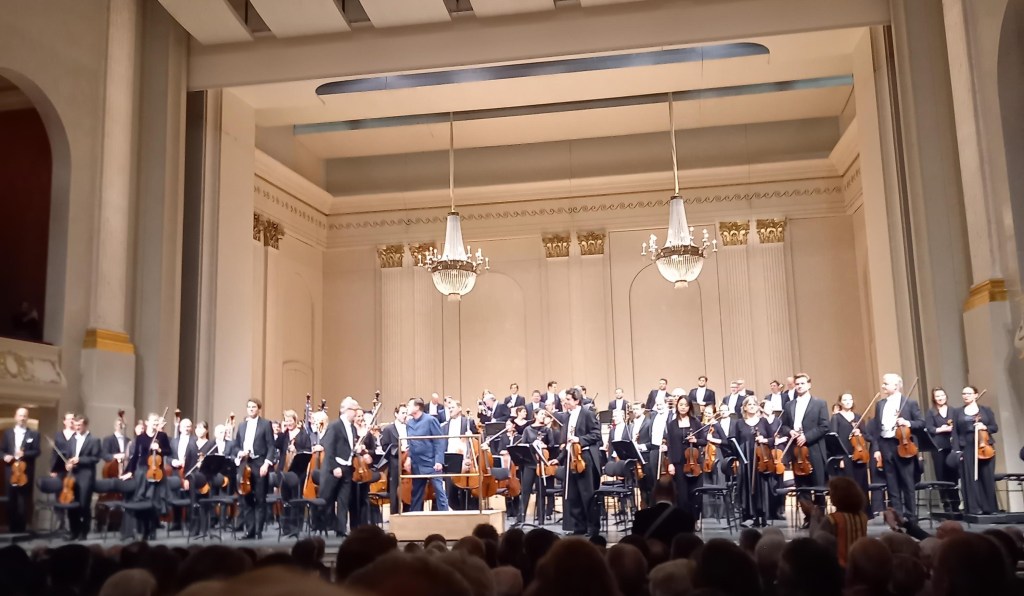
I heard the Berlin Staatskapelle play Bruckner at the Proms under Barenboim in 2016 (they played Nos 4 and 6 symphonies) and in the same year I heard Thielemann conduct No 3 at the Proms with his (then) Dresden orchestra. The Staatskapelle sounded superb in the Albert Hall, and returned with Barenboim in 2017 to play two Elgar concerts. I wondered how they would sound in this Opera House, which is not particularly designed for an orchestral concert sort of sound. I also wondered exactly where they would be playing…………as you can see from the photo below, they played on stage with the pit covered. The sound is bright, forward and from Row 13 extremely exciting! I was also wondering what other performances I’ve heard of this – not many…….I remember a BBC Philharmonic concert about 10 years ago – it might have been conducted by Simone Young. Other performances I am pretty sure I heard in the 70’s were conducted by Jascha Horenstein and Bernard Haitink. That’s about it……
But I have to say this absolutely thrilling performance was by far the best I’ve been to live – utterly memorable. I was completely gripped throughout (which doesn’t necessarily happen with me and this symphony listening at home – I find my mind can wander in the finale). There were several reasons for the excellence of this performance:
- the absolutely glorious sound of the orchestra, particularly in this space – golden brass, characterful woodwinds, deep rich strings and a seriously noisy timpani player (the violins were, thank goodness, split, which definitely helps the texture in a piece like this).
- the clear structure of the performance. Unlike say the 7th Symphony, where the emotional heart is in the slow movement climax, the 5th Symphony’s climactic point is in the last movement and at the very end, in the chorale which rides triumphantly over the rest of the orchestra in the brass. Any effective interpretation of this work needs to keep something in reserve for the ending. Thielemann and the orchestra delivered this in spades. You simply couldn’t believe the chorale could get any louder as it moved towards the final bars in the brass, with strings being urged by Thielemann to pile on the pressure with their runs – but it did!
- Thielemann’s attention to the inner parts of each movement. This is perhaps based as much on observation as sound, but it is noteworthy how detailed Thielemann is in his cues to players, and how you can both see and hear how he is bringing out a range of colours behind the dominant melody at any moment.
- each movement was beautifully characterised. A very quiet opening led to an extended exposition in the first movement which clearly differentiated the ? three different themes (which will come up again in the finale) and never sagged. The second theme of the slow movement was simply gorgeous and devastatingly moving, but fully integrated with the trudging first theme (clear link with the equivalent in Schubert 9) and the movement was beautifully shaped towards its melancholic and perhaps despairing climax. The third movement was glorious in its spaciousness and again I found myself listening to this more intently than I normally would
- the speeds for each movement seemed exact right. Thielemann, from what I’ve heard of his work, is not a portentous lingerer, and, for instance, the speed of the slow movement’s second subject felt just right – not too slow, not too fast
Another aspect of going to a Thielemann concert is watching him conduct. I’ve already mentioned the detailed cues – he is also astonishingly energetic for someone who is after all in his 60s. It is an energy not intended for the audience but to convey dynamism to the orchestra – a form of showing commitment that demands commitment in return. It’s quite something to watch.
As I have said frequently in these pages, a great Bruckner performance puts together the lyricism of Schubert, the quiet, austere mysteries of the divine, and the blazing majesty of Wagner. I thought Thielemann and the Staatskapelle captured all these different dimensions in this performance
 John's musical journey