The English Concert; Tim Mead, Amadigi; Hilary Cronin, Oriana; Mary Bevan, Melissa; Hugh Cutting, Dardano. Kristian Bezuidenhout, Director
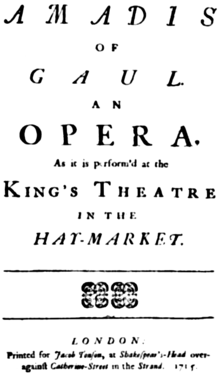
(Cribbing mainly from Wikipedia), Handel composed Amadigi in 1715 for Richard Boyle, 3rd Earl of Burlington. The work was premiered in London at the King’s Theatre in the Haymarket on 25 May 1715. Exceptional care was lavished on the production, which was a success. The King attended several performances (but was then put off going to more by the 1715 Jacobite rebellion, which meant that it was unsafe to appear in crowded venues. The opera received a known minimum of 17 further performances in London until 1717 and 17 after that in Hamburg. The opera then was not revived until 1929. Amadigi was written for a small cast, employing no voices lower than alto. The opera is scored for two recorders, two oboes, bassoon, trumpet, strings, and basso continuo (cello, lute, harpsichord).
Two of the singers were known to me – Tim Mead had been Oberon the previous month at Glyndebourne, and Mary Bevan had sung gloriously in Alcina a little less than a year ago at ROHCG. The other two singers I was unfamiliar with.
This was a full-on 3 hours of recitative and da capo arias, which was very enjoyable. It’s a young man’s work – Handel was 30 when he wrote it – and it fizzes with ideas and energy. As with Haydn you just marvel at the fertility of the work’s invention and how sometimes quite simple melodic lines are gorgeously wrapped around with orchestral decoration. As indicated above, it’s using a relatively large orchestra which means more orchestral colour – at times some of the arias began to sound a bit like the Royal Fireworks music (even though that was 34 years in the future), particularly the undoubted showstopper of the work, Melissa’s Destero dall’empia Dite, which unleashed a storm of applause at the end of Act 2. But there are many other arias that I’d want to hear again – Melissa’s lament in Act 1 (there’s an awful lot of lamenting in this work) ‘Ah! Spietato!’; Oriana’s beautiful Siciliana ‘Gioie, venite in sen’; Amadigi’s opening aria in Act 2 ‘Sussarate, onde vezzose’; Dardano’s last aria (with ear-wormy string accompaniment) ‘Tu mia speranza ‘, and Amadigi’s last triumphant aria with trumpets ‘Sento la gioia’.
The opera was clearly originally intended to be a stage spectacular, with dance sequences (the music for which is now lost) and complex transformations with, as the original 1715 publicity had it “a great many Scenes and Machines to be mov’d”. It also has the smallest number of roles in any Handel opera. The plot of course is notably silly – the wicked witch Melissa loves Amadigi who loves Oriana, who is loved by Dardano. It ends with Dardano dead, Melissa powerless and Amadigi and Oriana together.
The performance was strictly a concert one, with music stands and scores. It was being recorded and filmed for some purpose or other (odd, since Bevan and Mead recorded the opera last year). All 4 soloists were excellent. I even forgot Tim Mead was a counter-tenor and just enjoyed the beautiful phrasing and flexibility of his voice. Hugh Cutting was equally expressive though his voice was perhaps less distinctively beautiful than Mead’s. Mary Bevan and Hilary Cronin were both outstanding – Bevan of course is an already established artist but Cronin must surely have a great career ahead of her.
There were two other contributors to my enjoyment of the evening. One obviously was the English Concert, which buzzed with energy and colour, with lovely woodwinds, horns and trumpets and whose strings were constantly energising the music. The other was the church itself, which had surprisingly supportive acoustics and good sightlines ?(the odd pillar apart). More or less contemporary with the opera (completed 1724) I imagined Mr Handel himself attending the occasional service or concert here in his later years.
I’ve now heard 15 Handel operas live; only 30 approx to go!
 John's musical journey