Gewandhaus Orchestra, MDR Radio Choir, Leipzig Opera Chorus, St. Thomas Choir Leipzig, Gewandhaus Choir, Gewandhaus Children’s Choir, Andris Nelsons conductor, Emily Magee soprano (Magna Peccatrix), Jacquelyn Wagner soprano (Una poenitentium), Ying Fang soprano (Mater gloriosa), Lioba Braun mezzo-soprano (Mulier Samaritana), Gerhild Romberger mezzo-soprano (Maria Aegyptiaca), Benjamin Bruns tenor (Doctor Marianus), Adrian Eröd baritone (Pater ecstaticus), Georg Zeppenfeld bass (Pater profundus): Symphony No 8.
The other thing that’s happening in Leipzig at present is the largest annual Goth festival in the world- https://wave-gotik-treffen.de/english/info/info.php . There are huge numbers of people in black, many with chains, women with spiked hair in unusual colours and heavy make up/white faces, and blokes with pony tails, various sort of hats, particularly top hats, and tatoos. There’s even a Pagan Village somewhere – most are middle-aged, some staying in the same hotel as me.
So…..on now to the big one. The last Mahler 8 I heard was in early 2020 in Birmingham conducted by Mirga. It was quite driven, but very good. The other Mahler 8’s I’ve heard over the years have been conducted bu Colin Davis and Pierre Boulez – I remember also Charlie Groves in the Ally Pally, oddly, in about 1971 (which felt very much like the huge exhibition space in Munich, holding 3000 people that was the site of the first performance in 1910, and Mahler’s greatest public triumph), and a performance that might have been at the old Free Trade Hall in Manchester by Kent Nagano in the mid 1990’s. Mirga’s was probably the best I’ve heard. I found myself remembering before the concert started about my father – who had left school at 14, who had little knowledge of classical music and had only ever been to one or two concerts but who was nevertheless so bowled over by watching a Proms Mahler 8 performance on TV that he instantly demanded a recording of it for his next birthday present – we should make no assumptions about who can be responsive to and affected by Mahler’s music…..
I used to find this work difficult to take in – what was in particular Goethe’s Faust doing alongside a medieval hymn. Various talks and books – particularly Stephen Johnson’s book ‘The Eighth’ – have led me to more fully understand that both parts of the work’s text are glorifying Eros, the creative Spirit, the anima – whatever we might call it, that which leads us on to be more human, more creative, more fully aliive
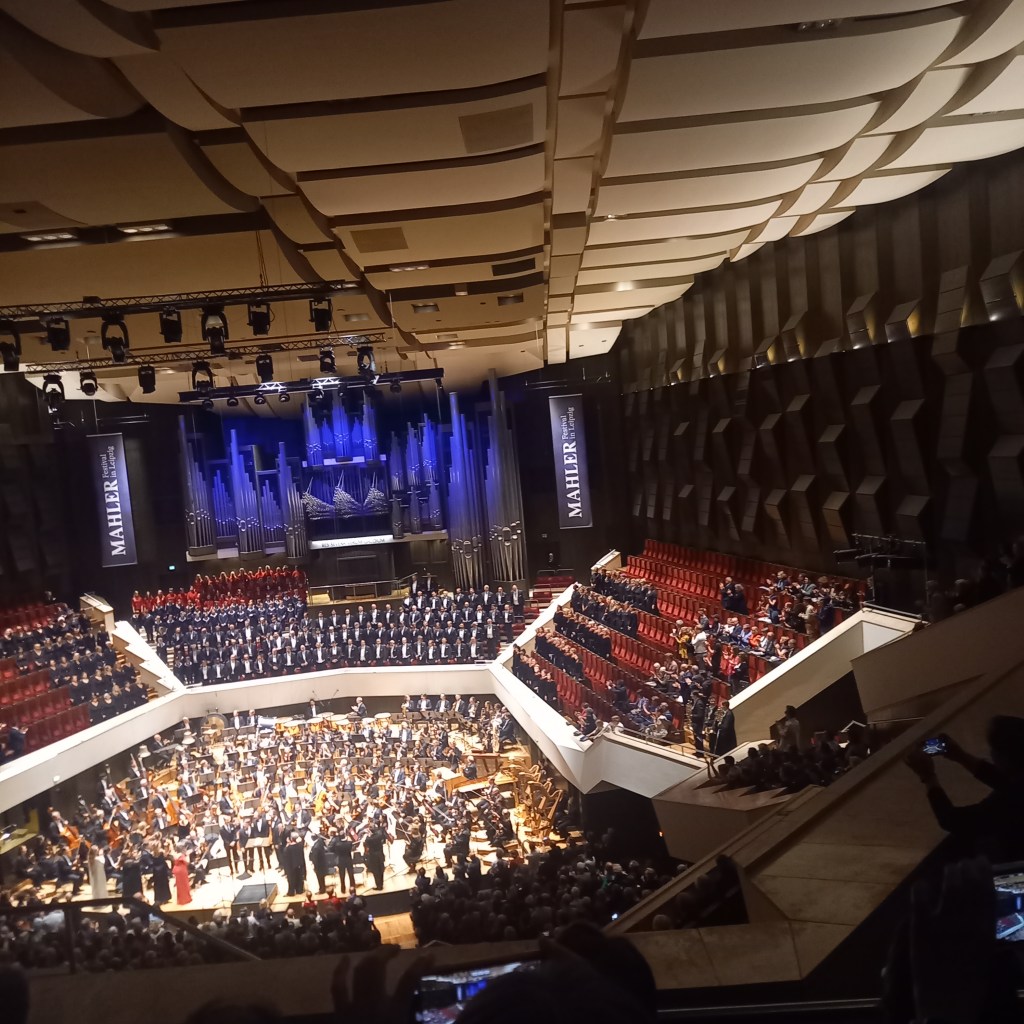
Certainly everything seemed fully alive in this performance, where things came spectacularly together, and I thought it had to be the best I’ve ever heard live. The combined forces of the various choruses weren’t huge (see picture) but, given the acoustics of the hall, they sounded wonderful anyway –from where I was sitting the men sounded slightly stronger than the women, because all the men were in the middle of the choir seats in front of the organ, while the women extended to the wings on either side. The children – including the Thomaskirche boys’ choir – sounded very clear. The orchestra played extraordinarily well, sounding particularly sumptuous. The soloists for the most part sounded great, though the tenor seemed to be straining occasionally – the ones well-known to me, Emily Magee and Georg Zeppennfeld, were also those who stood out as soloists. .
Most importantly from my perspective Nelsons got all the tempi right – there was nothing which sounded too slow or too fast. To give some examples, the slow down for the huge orchestral build up to, and the choral shout off ‘Accende’ in the first half was at first enormously expansive and then with the choral entry shot forward. The venom of ‘Hostias’ was just right. The slow down at the end of the first movement just before the entry of the additional brass was wonderfully managed, so that it sounded majestic rather than like Mirga’s bolting horses. In the second part the strings were encouraged to be gloriously sumptuous at the beginning, and the various changes of mood – eg to and from the celestial boys’ music – were handled without bumpiness. Stephen Johnson had mentioned in his pre-concert talk that there’s a particular moment after Dr Marianus’ concluding passage, where glockenspiel and celesta glitter, and high flutes and clarinets ponder, which sounds both like the conclusion of Das Lied von der Erde and seems to reflect on Mahler’s view of himself as a stranger everywhere, almost as if he’s wondering whether the concluding glorious noise is really what he wants. That passage was particularly poignant in this performance. The chorus and the orchestra at the end were overwhelming, and – praise be – there were particularly effective gong crashes, which sometimes get overlaid with other orchestral sounds in some of the live and recorded performances I’ve heard
 John's musical journey