Siegfried, Stephen Gould; Gunther, Michael Kupfer-Radecky; Alberich, Olafur Sigurdarson; Hagen, Albert Dohmen; Brünnhilde, Iréne Theorin; Gutrune, Elisabeth Teige; Waltraute, Christa Mayer; 1. Norn, Okka von der Damerau; 2. Norn, Stéphanie Müther; 3. Norn, Kelly God; Woglinde, Lea-ann Dunbar; Wellgunde, Stephanie Houtzeel; Flosshilde, Katie Stevenson. Valentin Schwarz (director), Andrea Cozzi (designs), Andy Besuch (costumes), Konrad Kuhn (dramaturgy). Reinhard Traub (lighting), Luis August Krawen (video), Bayreuth Festival Chorus and Orchestra, Cornelius Meister (conductor
So….onto Gotterdammerung. I will put forward a few views first on where I am in my assessment of this production, and will make any changes after I’ve seen Gotterdammerung. My assessments will be based on the following criteria, as I mentioned in my Rhinegold review
1.The quality of the concept (if there is one) and relevance to the opera (s)
2.Consistency in the implementation of the concept
3.How that concept relates to what the words and music are telling you
4.The insights which the approach brings to the work(s)
5.The quality of singing, conducting, acting and orchestral playing.
and I have added a 6th – the quality of the set design and the appearance of the production
On 1 – Schwarz himself says “The fact that the “Ring” in Bayreuth is performed in its entirety within just one week gives us the opportunity to show a family epic in a four-part series format and to follow these characters in their circumstances and omissions through the course of time. Where are you from? Where are you going?…”; “I want to tell a story about today’s people, today’s figures, today’s problems – and not about gods, dwarves, giants and dragons.” In another interview he talks about this being the ‘Netflix’ approach. The problem is that The Ring is inherently bursting with meaning – meaning is what Wagner intended it to have, even if he was in two or minds as to what, and so Schwarz’s concept sounds weak, though plain story-telling of course as such must be a virtue. There is a theory of theatre which is reflected in one of the essays in the programme book which is an approach that the theatre should reflect the disorder and lack of logic in the world we live in – ‘coherent incoherence’. This does seem relevant to this production.
On 2, the problem is that, having indicated that plain story–telling is what he plans to be doing, Schwarz starts importing a lot of action/signs that immediately disrupt that and suggest ‘meanings’ (the Rhinegold being a child, the pyramids, the various other children who pop up etc). I saw a Facebook post from a French guy attending Ring III saying that he was convinced it was all about the quest for eternal youth in a world of decay and death. This makes some sense but (a) is not what Schwarz said he was doing (b) is not followed through in any coherent way. People perhaps are attempting to find ‘meaning’ when maybe it is just not there. Of course, ‘coherent incoherence’ (or the other way round) might be an explanation, but then themes move in and out of view which suggests that this approach isn’t followed consistently either – at times some of the themes seem more systematically treated…… at other times less so. There are themes you can discern if you go with the flow – the abuse of children in conflict and by power; violence against women; flashy consumerism; even climate change. But it never really comes together. Quite often too in this production the plain story-telling seems to be deliberately obscured – e.g. there doesn’t seem to be any real reason why it should be Wotan rather than Siegmund who fathers Siegfried). Unless these issues are cleared up in Gotterdammerung…….
On 3, most of the time there is a fair degree of coherent relationship between action, words and music, even if it’s not conventional – it doesn’t really matter that there’s no dragon or bear. But there are certain symbolic things – spear and sword are the obvious ones – which can’t be air-brushed away in the manner Schwarz suggests. I wasn’t too bothered by the plastic surgery Valkyries or Mime’s anvil-less forging scene.
On 4, there are some insights – I have new perspectives on Fricka for instance, I think the way Siegfried is played is also effective, and different in the degree of thuggishness involved.
On 5, the singing so far has been of the highest quality – quite outstanding; the cast has acted well; for the most part the orchestra has played well, though not achieving the sort of sounds I heard in 2017 under e.g Thielemann. The conducting has been reasonable but not inspired (but there is the benefit of doubt to be given, granted the circumstances of 3 weeks’ notice)
On 6, too, as often in Bayreuth, the sets are stunning to look at ,
So……onto the Prologue and Act 1. The curtains open on a child’s bedroom – the same one as the fantasy one in Act 1 of Walkure. Brunnhilde is putting the chid to bed. The Norns come in as the child dreams, I think (though oddly there seem to be 4 Norns, rather than 3 – maybe one is the child in the dream. Similar Norn like figures also were around in the bedroom in Walkure. When Siegfried and Brunnhilde meet in the room after dawn breaks it is clear this is their child – though whether she is also the child who was led away by Erda in Rhinegold isn’t clear – and also that they are not getting on very well (this is how I read it anyway) and Siegfried goes off in a huff. The Gibichung Hall is another plush apartment with lots of staff and plenty of bottles of champagne – white seats and various bits of modern art. Gutrune looks like a sleek oligarch’s daughter and she’s certainly not ‘wet” in the way she’s portrayed in many productions. Gunther is as he should be unreliable and passive – he is also, in this production, just rather strange…very hyper-active, and exaggerated in his movements. He also sported at least in the first performance a T- shirt with ‘who the fuck is Grane’ written on it? I was too far away to see whether this was still around for Ring III….Hagen is slobby and into middle age, still wearing his trademark yellow T-shirt. Because the Tarnhelm and magic potions are, well, magic, and therefore against the concept, clearly Mr Schwarz has to arrange something to enable to Siegfried to win Brunnhilde for Gunther as his wife. His decision is to indicate that Siegfried is so fed up with Brunnhilde that he immediately falls for Gutrune (who is indeed very easy to fall in love with) without any magic potion. Grane is very disturbed by the whole Brunnhilde/Siegfried relationship collapse and tries to restrain Siegfried – he has the offered potion from Gutrune poured over his head. We see later that the Gibichungs have killed Grane and chopped him up – he is wheeled in on a bloody trolley during Hagen’s Watch. Back in the child’s bedroom Brunnhilde meets Waltraute ‘normally’ and the scene where Siegfried is disguised as Gunther, which is usually difficult to bring off, was no more or less messy than other productions – in this one both Gunther and Siegfried appear but with Siegfried out of sight singing for Gunther. The abduction of Brunnhilde is nasty – but, then, that’s what it is. Throughout the scene with Brunnhilde the child is present and she is taken with Brunnhilde to the Gibichung Hall. A lot of booing accompanied the curtain coming down at the end of the act – though for the production, not singers.
Act 2 was better. The first thing we see is a punch bag which Hagen is working out with. He hides behind the punch bag when Alberich appears and answers from the same position. The set remains essentially remains a white box throughout the act, but opens up effectively at the back with mist and darkness as Hagen’s vassals come on stage. Apart from the fact that the vassals have red Viking-type face masks – but, hey, why not?- the rest of the Act is conventionally handled within the white box and the singers just do their thing. The child is present for part of the wedding scene and there are some indications she can be identified with the Ring
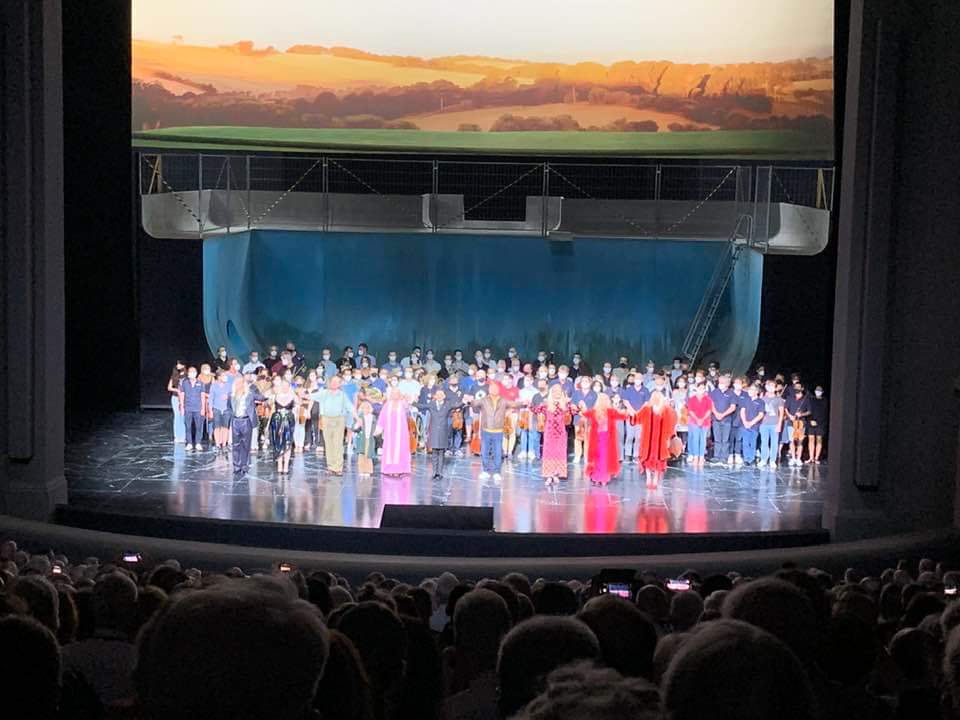
Act 3 was, frankly, dire. The setting was the same throughout – a cross section of an empty cracked and ruined swimming pool. Obviously this connects with the swimming pool of the Rhinegold and here represents a certain sort of futility and pointlessness to everything, I suppose. I have seen an argument from one critic indicating that the empty pool represents the impact of climate change, brought about by trashy consumerism represented by the Gods and Gibichungs – but this should have been woven into the fabric of the 4 evenings in other ways. The swimming pool has a higher level where vassals, Gutrune and Gunther gather and from where Brunnhilde starts her immolation scene and then there’s the bottom of the pool where Siegfried and Hagen are. The child is with Siegfried when he dies but disappears half way through the immolation scene and is, I think, killed. What is quite shocking, given the vividness and splendour of the music, is that more or less nothing happens on stage (apart from Gunther’s death) until the end of the opera, essentially. There is no movement of Siegfried’s corpse anywhere- it stays at the bottom of the swimming pool; Hagen dumps the severed head of Grane in a plastic bag halfway through the Immolation scene. Brunnhilde collapses on top of Siegfried. Hagen’s “Back from the Ring” is meaningless as there is no ring of any sort around. As Valhalla goes up in flames columns of strip lights appear on the back drop – what this might mean is entirely unclear. Finally, in a way that seems more of a gesture than anything else, the foetal image of the twins appears again. All this seemed a dire abrogation of directorial responsibility when the music intimates so much.
The singing and playing was another matter, happily. The cast was uniformly very good indeed. In advance, one wondered about Irene Theorin’s capacity now to take on this enormous role, but I found her to be very impressive, even if unflatteringly dressed and not really looking like the redemptive figure she’s meant to be (but which Mr Schwarz is denying) – some of the audience had it in for her during the curtain calls, which I thought was sad. On this subject see https://slippedisc.com/2022/08/at-bayreuth-brunnhilde-gives-one-finger-to-the-booing-audience/ .Stephen Gould was similarly impressive and strong voiced – though he ducked a few of the top notes – and I was as impressed by his Siegfried as I was by his Tristan 5 years ago. Hagen, Gunther and Gutrune all sang well. The orchestra sounded glorious throughout as did the Chorus. The audience interestingly seemed to have decided Cornelius Meister was doing a good job – no booing for him, unlike the first run of this production. There were still a few of his trademark lurches and lunges but all in all I felt he had conducted the work well.
All the judgements I made above before this performance stand – indeed are intensified. At the heart of the problem is a weak concept which is then further pushed off the rails by any number of ideas which start off well and then trail off. I have no idea what has happened – was there not enough time to think it all through (but it can’t be this, given that the production has been pushed back). Is it the ‘coherent incoherence’ deconstructionist ploy against ‘big narratives’. Possibly, but the impression given is simply one of incompetence. But I have a further sense that in retrospect the production does have a haunting quality – there is an underlying theme, not treated systematically, of not only the quest for wealth, power, and money, but also of the human urge for survival, to seek permanent youth, for regeneration, inheritance, renewal, perpetuation, innocence perhaps, in a world where on the contrary everything eventually ceases to exist or gets corroded, ages, corrupts, degenerates, or dies. Climate change is part of this overarching vision
Anyway, it is still a marvellous experience to hear this work where it was first performed in its entirety, and with its wrap-around mystique. The singing and eventually the orchestra were glorious. A pity about the production…as it stands, but it would be very interesting to see how it has developed in three years’ time in 2025 and to see how many second thoughts there have been…..And of course 2026 is the new 150th anniversary Ring.
 John's musical journey