Jean Sibelius, Tapiola; Franz Liszt, Piano Concerto No. 1 in E flat major’ Richard Strauss, Ein Heldenleben: Yuja Wang, piano; Oslo Philharmonic Orchestra, Klaus Mäkelä – conductor
Despite Norman Lebrecht’s lurid warnings (and I don’t deny his underlying thesis about the diminishing market for classical music) the Proms seems to be doing pretty well in terms of audiences as the season progresses – the last 3-4 concerts have been, as I understand it, pretty well-attended, and this Friday concert with the Oslo PO was absolutely jam-packed, with a full arena, circle and stalls. Part of that no doubt was the Yuja Wang factor – however, almost nobody left at the interval so the audience was clearly there for other reasons as well. It really felt as though pre-pandemic times had returned….
One of those other reasons might have been the much-hyped young Finnish conductor, Klaus Mäkelä. I was in a Choir seat near to the organ which is good for watching the conductor and his interaction with the orchestra, though imperfect for orchestral balance, with the horns immediately in front of me (all 8 in Ein Heldenleben) and the timps and percussion to my left. Thus I can’t really comment on Mäkelä’s competence in getting the orchestra to hear itself and to balance the different blocks of instruments effectively, but it’s obvious that he is a lively (indeed charismatic) presence on the rostrum – a very clear and elegant beat, acute attention to what the orchestra is doing, and a kind of rhythmic propulsion in his movements which supports and encourages similar energy in the orchestra. The latter were clearly enjoying playing for him and appreciated his presence very fully at the end.
Another reason for a large audience turning out might have been the Oslo Philharmonic, which has had a distinguished roster of chief conductors over the years – Blomstedt, Previn, Jansons, Vasily Petrenko and now Mäkelä. Though not in the Leipzig Gewandhaus class, they have a warm and polished sound, with a particularly good horn section and very solid brass – the woodwind on the whole didn’t seem to shine to the same extent in this concert. It was impossible to judge the string sound from where I was sitting, but my impression was – very good indeed!. Sitting close-up, I was aware of one or two orchestral mis-steps during the evening, but nothing very alarming or problematic, and totally understandable on a hot evening and in the middle of an extensive European tour.
‘Tapiola’ is a piece I tend to respect rather than warm to. This performance seemed to be very effective in conveying the brooding sense of the dark masses of Scandinavian forest, with very clear textures, though, as in other performances I’ve heard, I get a bit lost in trying to get my head round the piece’s structure. The violas in particular played beautifully at points (I point them out because they were to the right of the conductor so came across very clearly to me from my vantage point).
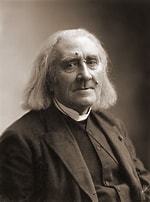
The Liszt concerto I always find an annoying and vacuous piece. But I have a lot of time for Yuja Wang, and she did her best with the concerto – though people can sometimes be a little sniffy about her, and make vaguely racist comments about ‘all-technique-and-no-heart’ etc, I have to say I find her playing not only (to the best of my understanding) technically extraordinary but also full of delicacy and contrast. I tend to think of the Liszt concertos as galumphing and strident rather than delicate, but Yuja brings out more of that latter quality than anyone else I’ve heard, and with some beautiful exchanges with some of the solo or near solo instrumentalists in the piece eg the clarinet. She almost made me like the piece. Should I mention….? (yes, I will) …….she was also wearing a stunning sparkly pink extremely short dress and extremely high heels…….(sorry). She gave two encores – some sort of variations or piano fantasias based on themes from Carmen and Gluck’s Dance of the Blessed Spirits. I have no idea who wrote the Gluck piece – conceivably it was by Liszt or perhaps Busoni; the Carmen was by Vladimir Horowitz, and they were both brilliantly and tastefully done. I think Yuja Wang is a remarkable artist – one of the finest pianists we have at present, from my admittedly non-technical knowledge.
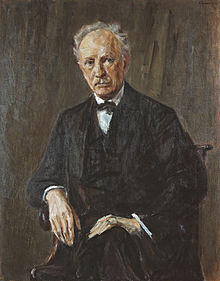
The word I want to use for the Heldenleben performance is …exciting. It was a really thrilling performance. It didn’t have the exquisite sounds, or the ‘inwardness’ of the last 10 minutes or so or the orchestral clarity of the Gewandhaus performance I reviewed in May, but it was just tremendously gripping in all the big moments, and Mäkelä managed to keep up the tension even during the wandering violin ‘Pauline’ passages – aided by an outstanding leader of the orchestra and some very good orchestral soloists e.g. the horn. The battle scene made an enormous racket and the return of the opening theme was truly viscerally thrilling, while the ending, with its echo of the opening of Also Sprach Zarathustra, was spine-tingling. The music never seemed raucous or over-blown, which it can do in the wrong hands.
All in all, a very enjoyable concert. The orchestra did a lively encore which was vaguely familiar – I thought it was maybe a Hungarian dance by Brahms, but apparently it was the ‘Ritter Pazmann’ csardas by John Strauss II – quite why the Hungarian theme I’m not sure….
All in all, the Oslo Philharmonic thoroughly deserves its nomination for the Gramophone magazine Orchestra of the Year Award.
 John's musical journey