Conductor, Ulf Schirmer (with the Gewandhaus Orchestra), Director and Designer, Roland Aeschlimann; Costumes, Susanne Raschi; Lighting, Lukas Kaltenbäck. Kundry, Elena Pankratova; Amfortas, Mathias Hausmann; Titurel, Randall Jakobsh; Gurnemanz, Rene Pape; Parsifal, Andreas Schager; Klingsor, Falk Struckmann
I booked this a long time ago, during one lockdown or other, when being able to go to Wagner again seemed a distant dream……The cast looked distinguished – Elena Pankratova and Andreas Schager were both in the 2017 Bayreuth Parsifal I went to, and Rene Pape is a well-known bass (though disgracing himself recently by a disparaging tweet about the Met’s gay pride celebrations, which he claims happened when he was drunk – in advance I hoped he was sober for this performance).
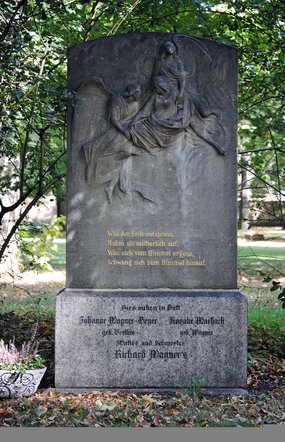
I spent the morning of the performance looking round Leipzig including going to a fascinating (though only in German, but still I got the gist, and the images were nearly all new to me) exhibition organised by the Wagner Society of Leipzig about Wagner’s childhood and up until his early 20’s. It included a portrait I’d never seen before of Wagner in his early 20’s, and also of his ? brother? cousin, Adolf, who looked extraordinarily like him, and his (rather beautiful, though no doubt a bit idealised in portrait), two sisters (? or cousins?) who as far as I could make out were both either on the stage or a musician. I hadn’t realised his mother lived until 1848, so would have seen her son make his way in the world and be kapellmeister in Dresden (and was spared the disgrace of seeing him flee for his life after the 1849 revolution). I also hadn’t appreciated that not only his father but also his step-father died when he was quite young
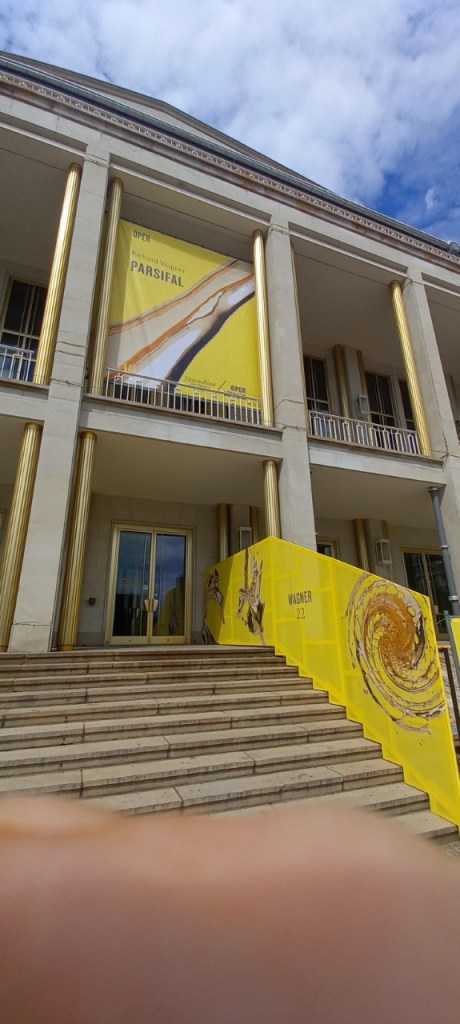
Anyway, to the performance……… The opera house in Leipzig is a fine GDR creation (photo below), very much less over-bearing and more welcoming than the huge Nationaltheater in Munich. The house was completely full.
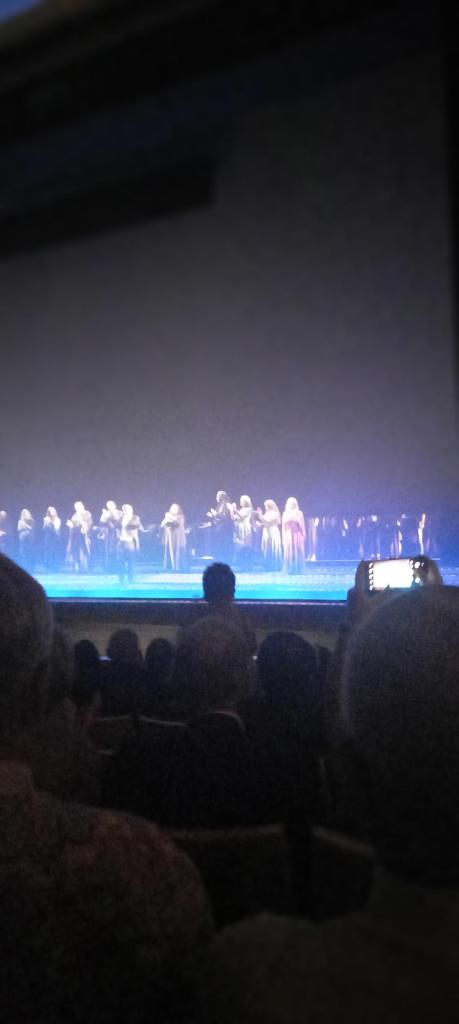
This was not one of those Wagner productions which seek to completely retell the story (the Berlin one set in a prison, and a recent Vienna one as well, I think) and was, with a few quirks, actually fairly traditional (it dates from 2006) and even on a few occasions seemed to refer back to Wieland Wagner’s Bayreuth production – for instance there is a backdrop of tree shapes in Act 1 Scene 1 which reminded me of that production, as well as Gurnemanz and the Knights /pages in that scene also looking Wieland-esque in long coats. The unchanging element in the set was a front gauze curtain which allowed some effective images but did make things murky and fuzzy at times, together with some very selective lighting on characters on the stage – particularly Klingsor, whose face was more or less completely blurred. There seemed to be writing on the steps at the front of the stage that was, maybe intentionally, undecipherable. The gauze curtain was underlit in blue for Acts 1 and 3 (though Act 3 Scene 1 was without the writing, and the writing, I think, disappeared during Act 3 scene 2). I had no clue what this writing was but somebody told me it’s actually a register of Grail knight. If so it plays no part in the action. The blue colour is still there in Act 2 but there are shifts towards slightly more emphasis on yellows and reds. There is move to green and blue in Act 3 scene 1 and then back to blue for the final scene. The stage is fairly bare but in the Grail temple there’s no chalice as such but an enormous circular flower-patterned window which, when Amfortas sends a signal with some sort of magic mirror (almost like an ipad!), opens up to reveal a kind of whirling conical shaped vortex constantly changing colours in Act 1, appearing at the furthest-away point of which is a pattern of red and white (maybe a few more colours) changing shapes. In Act 3, the vortex doesn’t whirl and instead there’s a much larger hologram not unlike a diamond – maybe a dodecahedron – possibly a reference back the medieval legends where the Grail is a magic stone. In Act 2, there is the same whirling vortex, but without the image at its centre – presumably as a kind of parallel to the temple – and on stage left high up is a suspended enormous spear, pointing downwards. For once the climax of Act 2 has a spear doing something,…. it moves upwards towards Parsifal. The knights in Act 1 scene 2 seem distant, (it’s not easy to see their faces) and almost automatons, with huge shields. It’s almost shocking when they move to close in on Amfortas in Act 3 scene 2 and threaten him. The most wayward part of the production is that at the beginning of Act 3 Scene 1 you see in addition to a withered tree a clump of about 50 shapes under white shrouds. During the Good Friday music Kundry gradually unwraps them – I thought at first, with a cringe of horror, that they were meant to be ‘new buds’ of some kind but realised afterwards that actually they are all in Buddha imagery. The sight of Kundry messing around with these shrouds is very distracting during some of Wagner’s most glorious music. On the other hand, the best part of the production is the handling of the end, which, as the vortex remains calm and the dodecahedron floats, has Amfortas and Kundry facing each other in redeemed love, with a solitary Parsifal almost within the vortex. This is a beautiful way of depicting on stage what is happening in the music. Parsifal has an odd costume in Acts 1 and 2 – a bit like a Pakistani peasant with baggy shalwar trousers. Kundry had a very unflattering dress, which she should have put her foot down about – Ms Pankratova looked much more seductive in the hammam in the Bayreuth production.
On the whole, then, though there seemed to be a lot of ideas that never got anywhere or completely added up, this production allowed the music to speak for itself and didn’t seriously seek to compromise its impact with its interjections, while only fitfully enhancing that impact.
Acting-wise, presumably there was relatively little time for rehearsal – the singers looked as though they’d been mainly left to their own devices. Parsifal had a jaunty approach to the role in Act 1 which he probably carries from production to production, though I seem to remember him looking more directed at Bayreuth. In Act 2, Mr Schager tended to go over-the-top in his actions and over-emote – for my taste, anyway. Ms Pankratova resorted to semaphore. Rene Pape was the singer who had best taken on board the old adage that most opera singers simply move around too much and that the most important thing is being still, and only moving when you have to…..
Music-wise it was a very much more distinguished story. For starters the orchestra of the Leipzig Opera is actually the Gewandhaus Orchestra, so this almost automatically elevates the musical quality – you’re listening to one of the great orchestras of the world….. I was sitting on the fairly extreme right-hand side of the auditorium so the sound for me was a bit unbalanced in favour of the brass, but that was my fault for leaving booking too late, not the orchestra’s. There was some magical woodwind, string and horn playing and, as in my reviews of the Gewandhaus Orchestra at the Barbican in May, just that sense of utter security that you get from a great orchestra, a willingness to play out fully and with confidence. Ulf Schirmer is leaving the Leipzig Intendant post after 11 years and this was his last performance – he took a measured approach – I think about 5-10 mins slower than Richard Farnes – but nothing dragged or felt too quick. There were three outstanding performers on stage. I have never heard Rene Pape live before. He may have unpleasant opinions, but his was the finest-sung Gurnemanz I’ve ever heard live– a beautiful and powerful voice, plenty of colour and variation, great diction. I thought this was in the Hotter league. Good though Toby Spence was in the Opera North performances, Andreas Schager showed what a real heldentenor can do with the part – a ringing powerful voice, and sensitivity in musically projecting the changing understanding of Parsifal on stage. His ‘Amfortas – die Wunde’ in Act 2 was quite extraordinarily powerfully sung. And Elena Pankratova was as good as Katerina Karneus of the ON concert performance in the sensitivity of her singing. However both the Klingsor and the Amfortas were also very good – just not in the same category of excellence. This was a luxury cast.
In the real world, this was probably about as good as it gets, currently, with live staged Parsifal performances. I enjoyed it hugely and was very moved, as I always am, by the profundity and greatness of this work

 John's musical journey